A Guide to Campaigns in Marketing
Learn to build winning campaigns in marketing. This guide covers strategy, planning, execution, and measurement for driving real business results.
What is a marketing campaign?
A marketing campaign is a focused, strategic effort designed to achieve a specific business goal. This goal might be increasing brand awareness, launching a new product, or driving sales.
Unlike individual marketing tasks, a campaign organizes multiple channels and messages under a single idea. It creates a cohesive story that connects with a specific audience over a defined period.
The Core of a Marketing Campaign
A marketing campaign is a project with a clear start and finish. Instead of sending emails whenever you feel like it or posting on social media randomly, a campaign gives those efforts a common purpose and theme. This consistency makes your message stick.
For example, a single tweet about your new feature is a marketing action. A full month of coordinated tweets, blog posts, influencer promotions, and paid ads all centered on that new feature launch is a marketing campaign. This coordinated effort gives your message real impact.
The Essential Components of Any Campaign
Every campaign, no matter the size, rests on the same foundational elements. These components give your efforts structure, a clear path, and a way to measure what works. If you skip these, you are just guessing.
Getting these elements right ensures your plan is solid and your goals are achievable.
- A Defined Audience: Who are you talking to? You need to know this. Building detailed customer personas is critical for understanding their problems and motivations.
- A Clear Message: What is the one thing you want people to remember? Your campaign needs to communicate a single, compelling idea that is consistent everywhere you share it.
- The Right Channels: Where does your audience spend time online? Pick the platforms where they are active, such as Instagram, email, search engines, or niche blogs.
- Specific Metrics: How will you measure success? You must decide what success looks like before you launch. Key metrics might be website traffic, new leads, or a specific number of sales.
A well-planned campaign turns random marketing acts into a strategic, measurable plan. It is the roadmap that gets your whole team aligned, clarifies what you want to achieve, and links every action back to a real business result.
Mastering these fundamentals is your first step toward building campaigns that deliver results. By focusing on these core parts, you set a strong foundation to hit your goals without wasting time or money.
Understanding Major Marketing Campaign Types
Think of marketing campaigns as tools. You would not use a hammer to saw a board. The same logic applies here. Picking the right campaign type is the first step toward hitting your business goals, because each one is built for a different job.
Some campaigns focus on getting your name out and introducing your brand to new people. Others are designed to find interested people and get their contact information. Many are focused on one thing: making the sale.
Each campaign has its own strategy, using specific channels and metrics to tell you if it is working. Let's review the most common ones.
Brand Awareness Campaigns
The point of a brand awareness campaign is to get your brand noticed. You want more people in your ideal audience to see your name, recognize your logo, and have a general idea of what you do. It is less about selling and more about building familiarity and trust.
Success here is not about counting immediate sales. Instead, you track metrics that show how much attention you are capturing.
Key metrics to watch:
- Impressions: The total number of times your ad or content was shown.
- Reach: How many unique individuals saw your content.
- Website Traffic: An increase in visitors to your site.
- Social Engagement: The likes, comments, and shares on your social posts.
These campaigns perform well on channels that can reach many people, like social media ads, compelling content marketing, and public relations.
Lead Generation Campaigns
People know who you are. What is next? The next step is to find out who is interested in what you sell. A lead generation campaign is designed to capture their contact information, like an email address or phone number. This action turns an anonymous browser into a lead, someone you can start a conversation with.
These campaigns work by offering a fair trade: something valuable from you in exchange for their contact details. This item could be a free guide, a webinar spot, or access to an exclusive newsletter. The goal is to build a quality list of potential customers for your sales team. You can learn more about how this works in our guide to successful email marketing strategies.
For lead generation, you measure success by tracking:
- Conversion Rate: The percentage of visitors who fill out your lead form.
- Cost Per Lead (CPL): How much you spent to get one new lead.
- Number of Qualified Leads: How many new contacts are a good fit for your business.
Sales Campaigns
A sales campaign is direct. It is all about generating revenue. These campaigns target people who are close to making a purchase. The messaging is direct and persuasive, often highlighting special offers, limited-time discounts, or product demos to encourage them to act.
These are the campaigns that have a direct, measurable impact on your revenue. Channels like paid search ads on Google, targeted email marketing, and retargeting ads are effective for closing deals.
Measuring success is straightforward. You look at the revenue the campaign brought in versus how much it cost to run. This gives you a clear picture of your return on investment and proves the financial impact of your marketing efforts.
To help put it all together, here is a quick summary of how these common marketing campaigns compare.
Marketing Campaign Types and Objectives
The table below shows the primary goal for each campaign type and the key metrics you will use to measure its performance.
Seeing them side-by-side makes it easier to choose the right approach for what you want to achieve.
How to Plan Your Marketing Campaign
Launching a marketing campaign without a plan is like sailing without a map. You might be moving, but you have no idea where you are going. A well-structured plan is your roadmap, making sure every dollar you spend and every action you take pushes you closer to your goal.
This process requires doing the foundational work first. It involves setting clear goals, understanding your audience, and picking the right places to reach them. This is what separates impactful campaigns from those that fade into the background.
Set SMART Campaign Goals
First, you need to define what a "win" looks like. The best way to do this is by using the SMART framework. It is a simple tool that forces you to move beyond vague ideas like "get more sales" and set concrete, measurable targets.
Here is how you can put the SMART framework to work for your campaign:
- Specific: Be precise. Instead of "more leads," make it "capture 500 new leads from our core Millennial demographic."
- Measurable: How will you track progress? Define the exact metrics, like a specific number of website visits or a target conversion rate.
- Achievable: Be ambitious, but realistic. Base your goals on your team's resources and what your past data shows is possible.
- Relevant: Make sure the campaign's goal supports your larger business objectives. Does it connect to your quarterly revenue target?
- Time-bound: Give yourself a deadline. For example, "achieve this goal within the next 90 days."
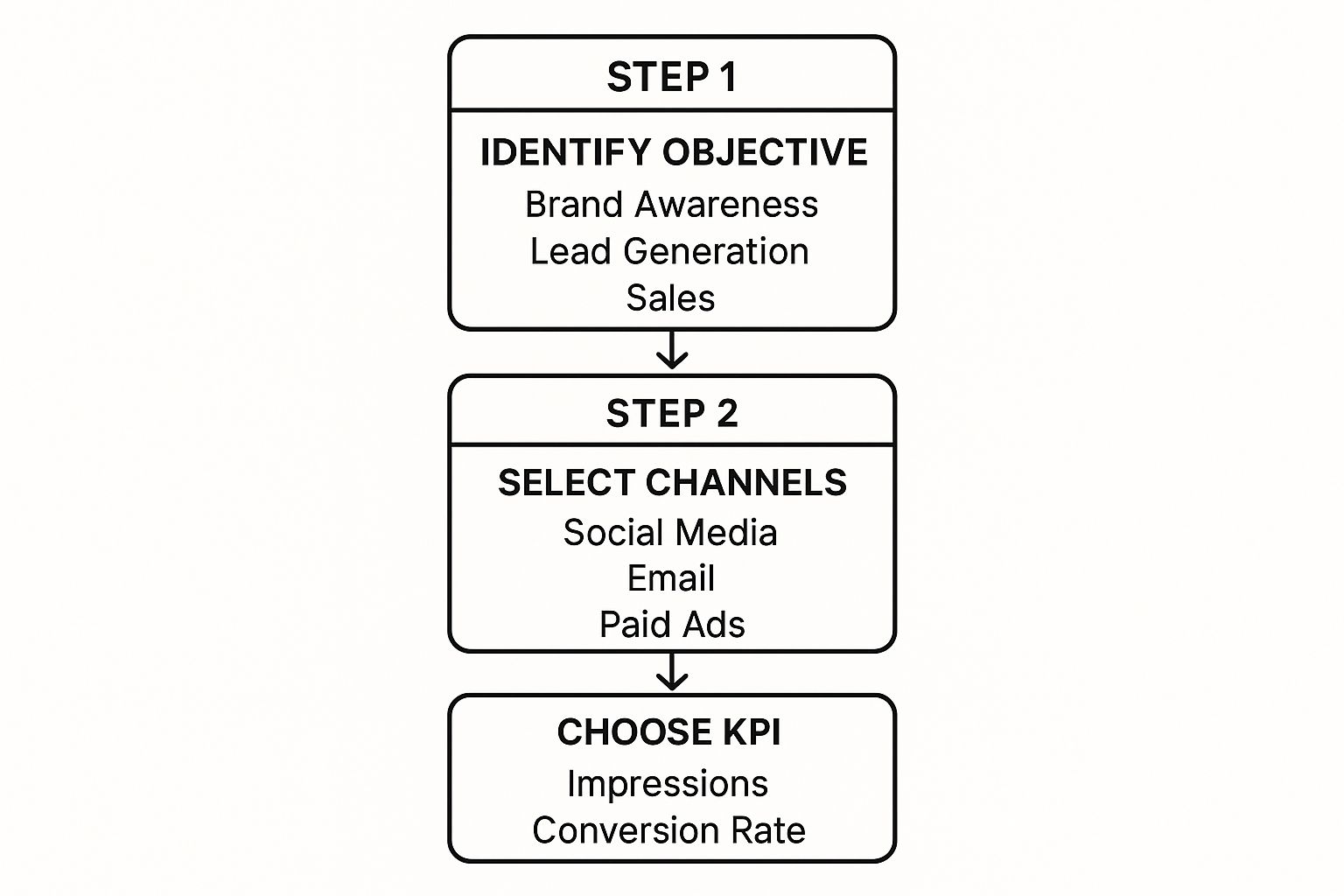
As you can see, every decision you make, from the channels you use to the KPIs you track, should flow directly from the objective you set at the beginning.
Define Your Target Audience and Message
You have your goal. Now, who are you talking to? This is where creating detailed customer personas is important. A persona is a character sketch of your perfect customer, built from market research and data on your existing customers.
Your persona should feel like a real person, with demographics, behaviors, motivations, and problems. When you understand them deeply, you can create a core message that connects with their specific needs. That message needs to be sharp, consistent, and instantly communicate why you are the solution they need. Getting this right is a huge part of any strong content marketing strategy for your business.
A well-defined message aimed at the right audience cuts through the noise. It focuses your energy on the people most likely to buy, making your entire campaign more efficient.
Select Channels and Set a Budget
With your audience and message defined, it is time to figure out where to deliver it. The trick is simple: go where your people already are. If your ideal customer is a B2B professional, LinkedIn is a good choice. If you want to reach a younger audience, you would look at platforms like Instagram or TikTok.
The online world is crowded. The average person sees between 6,000 and 10,000 ads every day, so picking your channels wisely is necessary. A focused, multi-channel approach is often the best way to ensure your message is seen and heard.
Finally, you need to map out a realistic budget and timeline. Your budget needs to cover everything from ad spend and creative production to the tools you will use. A clear timeline with key milestones keeps everyone aligned and ensures you are on track to hit your goals. This is the foundation of any great marketing campaign.
Bringing Your Campaign to Life: Execution and Management
The strategy is set, and the plans are made. Now you turn that hard work into action. This is where your campaign goes live, your creative assets reach the market, and you start seeing how your audience responds.
Success at this stage is about staying organized, keeping your message consistent, and being ready to adjust based on what the data tells you. It is not a "set it and forget it" task. It is more like actively steering a ship.

Think of this phase as a conversation. You put your message out, and the audience responds through their clicks, views, and shares. Your job is to listen to that feedback and adjust your approach accordingly.
Create Consistent Assets and Content
Your campaign needs to speak with one voice, no matter where people find it. Whether it is a social media post, a blog article, or an email, the core message and feel should be instantly recognizable. This repetition builds brand recall and makes your idea stick.
Each channel has its own rules. A TikTok video will look and feel different from a long-form article on your blog, but they should both echo the same central theme. Getting this right is a sign of effective marketing campaigns.
The secret to staying organized is a content calendar. This tool becomes the single source of truth for your team, mapping out what gets published, where it goes, and when.
A well-maintained content calendar keeps your team aligned and your messaging on track. It prevents last-minute scrambles and ensures every piece of content contributes to the campaign's objective.
A calendar lets you see the entire campaign at a glance. You can schedule posts weeks in advance, assign tasks to team members, and ensure you never miss a deadline.
Keep a Close Eye on Performance and Adjust
Once your campaign is live, your job shifts from creator to analyst. You need to check your analytics tools and watch your key performance indicators (KPIs) in real time. This is not about collecting numbers. It is about understanding the story they tell.
The data shows you what is working and what is not. This allows you to make smart, informed decisions instead of guessing what to do next.
For instance, if you see an ad on one platform is getting many impressions but has a low click-through rate, you can pause it. Then, you can shift that budget over to a different ad that is performing well. This constant cycle of monitoring and optimizing separates a good campaign from a great one.
Here are a few practical adjustments you can make based on what you see:
- A/B Testing: Run two versions of an ad with different headlines or images to see which one your audience prefers.
- Audience Refining: If your ads are reaching the wrong people, tighten your targeting parameters to find a better fit.
- Budget Reallocation: Do not be afraid to pull money from underperforming channels and increase spending on what works.
This hands-on, data-driven management lets you react quickly. By making a series of small, smart improvements, you can increase your campaign's overall impact and return on investment. In today's marketing, being agile is essential.
Tapping into AI for Modern Marketing Campaigns
Artificial intelligence is no longer a buzzword. It is a tool that is reshaping how marketers work. Think of it as a translator for massive amounts of data, turning complex information into clear, actionable steps. When you bring AI into your marketing campaigns, you move from educated guesses to data-backed precision, allowing you to automate tasks and connect with your audience in a more meaningful way.
This is not a passing trend. The shift is massive. The AI marketing market is on track to double from 20 billion** in 2022 to **40 billion by the end of 2025. You can learn more about what is driving this growth with these AI marketing statistics on cubeo.ai.
Getting Specific with AI-Powered Audience Segmentation
One of the first places you will see the impact of AI is in understanding your audience. AI algorithms can analyze huge amounts of customer data, including purchase history, browsing behavior, and social media interactions, and spot patterns a human team could not catch. The result is extremely specific audience segments.
Forget broad categories like "moms in their 30s." AI lets you drill down to create micro-segments. For instance, it can pinpoint a group like "users who viewed the pricing page three times this week, have not bought yet, and tend to watch video reviews on Saturday mornings."

This level of detail changes the game. It allows you to create messages that feel personal and directly relevant, which makes your campaigns far more effective.
Putting Key Campaign Tasks on Autopilot
Much of campaign management is repetitive and time-consuming. AI tools are perfect for taking these tasks off your plate, freeing up your team to focus on the big-picture strategy and creative thinking that humans do best. This is not just about saving time. It is about improving performance.
Here is where AI-driven automation shines:
- Smarter Media Buying: AI platforms can manage ad buys in real-time, constantly analyzing performance data to automatically shift your budget toward the channels and creatives that are delivering results.
- Personalized Email Marketing: AI can determine the perfect time to send an email to each person on your list. It can even help you create subject lines and copy that are statistically more likely to be opened and clicked.
- Faster Content Generation: Need a first draft for a social post, ad copy, or a blog outline? AI can produce one in seconds, speeding up your content pipeline while maintaining a consistent brand voice.
Predicting What’s Next for Better Optimization
Beyond looking at what has already happened, AI is good at predicting what will happen. By analyzing current data and market trends, AI models can forecast future customer behavior, giving you a serious advantage. This allows you to optimize campaigns on the fly, not just after the fact.
Predictive analytics lets you anticipate customer needs instead of just reacting to them. You can identify potential high-value customers or detect early signs of customer churn, allowing you to take proactive steps.
This forward-looking view makes for smarter budget allocation. If an AI model flags a coming surge in interest for one of your products, you can preemptively increase your ad spend to meet that demand. It makes your entire marketing operation more agile and more profitable.
Measuring Your Campaign's Success
Once your campaign is live, the real work begins: figuring out if it is working. This is not just about checking boxes. It is about proving the value of your efforts and finding clues that will make your next campaign even better.
Without a solid plan for measurement, you are flying blind, basing decisions on guesswork instead of hard evidence. Proper analysis transforms raw data into simple, actionable insights. This is how you justify your marketing budget and make smarter choices next time.
Key Metrics for Campaign Analysis
To get a true read on performance, you need to watch the right data points. These metrics tell a story, showing you how people engaged with your campaign, from the first impression to a final purchase.
Here are three core metrics that will give you a solid foundation:
- Click-Through Rate (CTR): What percentage of people who saw your ad or content clicked on it? A high CTR is a great sign that your creative and messaging are connecting with your target audience.
- Conversion Rate: This tells you the percentage of users who took the specific action you wanted, like signing up for a demo or buying a product. It is the ultimate test of whether your campaign is achieving its main objective.
- Cost Per Acquisition (CPA): How much did it cost you, on average, to gain a new customer from this campaign? A low CPA means you are running an efficient, profitable machine. You can learn more with this guide on calculating your customer acquisition cost.
Tracking these metrics is not optional. They give you the objective proof you need to evaluate success and clearly communicate the impact of your marketing campaigns to stakeholders.
Calculating Your Return on Investment
Beyond these individual stats, you have to look at the bottom line. Return on Investment (ROI) is the ultimate scorecard for your campaign's financial health. It answers one simple question: for every dollar we put in, how much revenue did we get back?
A positive ROI is your proof that marketing is a growth engine, not just an expense. Think about the massive opportunity on social media, where over 65.7% of the world’s population is active. As you can see on Sprinklr, this makes social a critical channel to analyze for ROI.
Finally, pull all of your findings into a straightforward campaign report. Lay out your key metrics, show your ROI calculation, and share the insights you have found. This document not only proves your campaign’s worth but also gives you a data-backed blueprint for what to do next.
Frequently Asked Questions
Do you have questions about running a great marketing campaign? We have answers. Here are a few common questions we hear, broken down to help you sharpen your strategy.
What is the secret to a successful marketing campaign?
It all comes back to knowing your audience. You have to really know them. You can have the best product in the world, but if you are promoting it in the wrong place or in a way that does not connect, you are just making noise.
Success is not about having the flashiest ad. It is about connection. When you understand your audience's problems, what motivates them, and where they spend their time, everything else falls into place. The messaging writes itself, and the channel choice becomes obvious.
A successful campaign is built on audience knowledge. Every decision, from messaging to channel selection, should flow from a clear understanding of who you are trying to reach and what they value.
How do I figure out the best channels for my campaign?
The golden rule is to go where your people are. Do not just guess or jump on the latest trend. You have to do some research on your audience's online habits and demographics.
Think about it this way:
- Targeting professionals? LinkedIn is a good choice.
- Trying to reach a younger crowd? You will want to be on platforms like TikTok or Instagram.
- Not sure? A smart mix of channels often works well, letting you connect with people at different points in their day.
It is about being strategic. Meet them on their turf, not yours.
How much should I budget for a marketing campaign?
The right budget depends on your specific goals, your industry, and the channels you have picked.
For a small business just starting out, a solid benchmark is to set aside 5% to 10% of your total revenue for marketing. But do not invest it all at once. A smarter approach is to start with a smaller test budget to see what is working. Once you have some real performance data, you can confidently increase spending on the channels that deliver the best results.
Ready to take your app marketing campaigns to the next level? Adworkly combines human expertise with AI to drive viral growth and optimize your ROI. Learn more at https://adworkly.co.