Mastering User Acquisition for Mobile Apps
Unlock scalable growth with our guide on user acquisition for mobile apps. Learn proven strategies for paid, organic, and creator-led campaigns.
When we talk about user acquisition for mobile apps, we're talking about the engine that drives new people to install and, more importantly, use your app. This isn't just about running a few ads; it's a strategic blend of organic efforts like App Store Optimization (ASO) and paid campaigns on powerhouse platforms like Meta and Google. But here's the thing: a winning strategy never starts with an ad. It starts with a rock-solid foundation built on who your ideal user is and what they're actually worth to your business.
Building Your Growth Foundation
Before you even think about spending your first dollar on advertising, the smartest app developers are busy laying the groundwork. This is the stuff that separates the apps that scale profitably from the ones that just burn through cash. It's about getting brutally honest and creating a data-driven plan that makes every future marketing decision smarter.
Think of it as moving from guesswork to a calculated strategy. This foundational stage forces you to define exactly who you're trying to reach, how much you can afford to pay for them, and what success actually looks like. Without this clarity, you're just throwing tactics at a wall, not building a cohesive, goal-oriented growth machine.
Defining Your Ideal User Persona
First things first, you need to know who you're talking to. And I mean really know them. This goes way beyond basic demographics like age and location. A powerful user persona digs into the psychographics, the goals, challenges, and motivations that drive your target audience.
For example, a fitness app isn't just for "women aged 25-40." A much more useful persona is: "Sarah, a 32-year-old marketing manager who's swamped between work and family. She feels guilty about not being healthier and is looking for quick, effective at-home workouts she can squeeze into her lunch break." See the difference? That level of detail tells you exactly what kind of ad creative, messaging, and even app features will grab her attention.
A well-defined user persona is your north star. It ensures your product development and marketing teams are perfectly aligned, building features and crafting messages for the same person.
To build this profile, start by analyzing your existing user data, sending out surveys, or even doing a few interviews. Your goal is to answer a few key questions:
- What problem are they trying to solve? What is their primary goal for using an app like yours?
- What are their biggest frustrations? What are the pain points in their current routine?
- What makes them act? What are the behavioral triggers that motivate them to try something new?
- Where do they hang out online? Which social media platforms, forums, or blogs do they scroll through daily?
Calculating LTV and Setting a Target CPA
Once you know who you're after, you need to figure out the economics. Two metrics are absolutely critical here: Lifetime Value (LTV) and Cost Per Acquisition (CPA). LTV is a prediction of the total revenue a single user will bring in over their entire time with your app.
From there, you can determine your target CPA, the maximum you can afford to spend to get a new user while still turning a profit. The math is simple: LTV has to be higher than CPA. A healthy benchmark many aim for is an LTV to CPA ratio of 3:1. This means for every dollar you spend to acquire a user, they generate three dollars in revenue, giving you a solid margin to work with.
Setting Up Your Measurement Stack
The final piece of the foundation is your measurement stack. This is the tech that tells you what’s working and what’s not. Without proper tracking, you're flying blind, throwing money into campaigns without knowing if they're actually driving valuable users.
The core of any good stack is a Mobile Measurement Partner (MMP). I'm talking about tools like AppsFlyer, Adjust, or Singular. An MMP acts as an unbiased referee, using a single piece of code (an SDK) in your app to track where every single install comes from. This is crucial for accurate attribution, preventing different ad networks from all trying to take credit for the same user.
With an MMP in place, the next job is to define and track your in-app events. These are the key actions that signal a user is engaged and finding value.
Think about actions like:
- Completing the onboarding flow
- Making their first purchase
- Beating level 10 in a game
- Using the "invite a friend" feature
By tracking these events, you can optimize your campaigns for what really matters: acquiring high-quality users who will stick around and contribute to your bottom line, not just cheap installs. This groundwork makes every marketing dollar accountable and truly sets the stage for scalable growth.
Driving Sustainable Growth with Organic Channels
Paid campaigns are great for a quick shot of adrenaline, but organic acquisition is what builds the long-term, profitable muscle for your app. These are the channels that create a real competitive moat, pulling in high-intent users without you having to pay for every single install.
When you're thinking about organic growth, you're really focusing on two things: getting discovered inside the app stores, and creating genuine value outside of them.
Get this right, and your marketing shifts from a monthly expense to an asset that actually grows over time. You create a powerful growth loop where more organic users boost your store rankings, which in turn attracts even more organic users. It’s a beautiful thing.
Perfecting Your App Store Optimization
App Store Optimization (ASO) is basically SEO for your app. It’s the entire process of making your app more visible in the Apple App Store and Google Play Store. And it’s not optional. With over 70% of mobile users finding new apps by searching the stores, you simply can't afford to ignore it.
The goal is two-fold: rank higher for the keywords people are actually typing in, and then convince them to hit "install" once they land on your page.
If you want to go really deep on the technical side, we've put together a complete guide on ASO fundamentals and best practices. But it all boils down to knowing what your users are looking for and making sure your listing gives it to them.
Here’s a quick-and-dirty checklist to get you started:
- Smart Keyword Research: Figure out what high-volume, relevant keywords your ideal customers are searching for. Use ASO tools to see what your competitors are ranking for and find gaps you can own.
- A Compelling App Title: Your title is a massive ranking signal. Stick your most important keyword right next to your brand name. A perfect example is "Calm - Sleep & Meditation," it immediately tells you what it does.
- Persuasive Subtitle & Description: This is your elevator pitch. Explain the problem you solve and what makes your app the best solution. Weave in your secondary keywords here, but keep it natural.
- An Iconic App Icon: Your icon is your first impression. It needs to be simple, memorable, and look good even when it’s tiny. Steer clear of text and go for a design that screams your brand.
- Engaging Screenshots & Videos: Don't just show your app; show it in action. Use text overlays on your screenshots to call out key benefits and create a punchy preview video to grab attention fast.
The Power of Ratings and Reviews
Good ratings and reviews are rocket fuel for both your store rankings and user trust. A high star rating is powerful social proof that tells the store algorithms and potential users that your app is high-quality. But you can't just sit back and hope for good reviews to roll in.
You have to be smart about when you ask. The trick is to prompt users for a review right after they’ve had a "win" or a moment of delight in your app.
For example, a fitness app could pop the review prompt after a user nails their seventh workout. Or a language app could ask after someone aces a tough lesson. You’re catching them when they’re happiest and most likely to share positive feedback.
Using Content to Drive Installs
Looking beyond the app stores, content marketing is an absolute beast for organic growth. The app ecosystem is projected to see over 300 billion downloads in 2025, which means the competition is fierce. Raw download numbers don’t mean much, especially when data shows only 26% of users come back to an app the day after installing it. Your job is to attract the right users from the very beginning.
This is where content marketing shines. You can create blog posts, guides, or free tools that solve problems for your target audience.
Think about a budgeting app. They could write a blog post called "How to Create a Monthly Budget You'll Actually Stick To." The article delivers real value, builds trust, and then, naturally, positions the app as the perfect tool to put that advice into action.
Every piece of content you publish becomes another pathway, funneling qualified traffic from Google and social media straight to your app store page. This isn't a one-off campaign; it's a sustainable growth machine that gets stronger every time you hit "publish."
Scaling Growth with Paid Acquisition Campaigns
Organic growth is your foundation, but paid acquisition is the rocket fuel. When you need to get your app in front of thousands of ideal users, and fast, paid campaigns are your best bet. This is where you strategically turn a marketing budget into a predictable stream of high-quality installs on platforms like Meta, Google, and TikTok.
But let's be clear: this isn't about hitting "boost post" and hoping for the best. Winning at paid UA requires a disciplined, data-backed approach. Each platform is its own ecosystem with unique user behaviors and ad formats, so a one-size-fits-all strategy just won’t cut it.
Structuring Campaigns on Major Platforms
One of the biggest mistakes I see teams make is lumping everything into one giant campaign with a massive, generic audience. The key to effective spending is a segmented campaign structure. This gives you precise control over your budget, lets you test messaging with different groups, and helps you pinpoint exactly which audiences bring in the most valuable users.
Here’s a practical way to think about it:
- Meta (Facebook & Instagram): I always start by targeting broader audiences based on the core interests and demographics of my ideal user personas. From there, I'll launch separate campaigns for lookalike audiences built from my best customers, the ones who spend money or use the app daily. The final layer is a retargeting campaign to re-engage people who checked out the app store page but didn’t quite convert.
- Google App Campaigns: Google’s power is in its automation, which runs ads across Search, YouTube, the Play Store, and more. Your job is to feed the machine learning algorithm the right ingredients. Give it a healthy mix of high-quality videos, images, and text snippets. Then, set clear goals, like a target cost-per-install (CPI) or a cost-per-action (CPA) for a key event like a sign-up or first purchase. We go much deeper in our expert guide on mastering Google Ads.
- TikTok: This platform is all about authentic, native-feeling content. Don't just run a polished corporate ad here. Structure your campaigns around trending sounds, popular formats, and user-generated-style videos. It’s worth testing formats like Spark Ads, which amplify organic posts from creators, to build social proof that drives a ton of installs.
To help you decide where to start, here’s a quick rundown of the major paid channels and what they do best.
Paid Channel Strategy at a Glance
This table should give you a solid starting point for allocating your budget and creative resources where they’ll have the most impact.
Mastering Your Creative Strategy
Your ad creative is the single biggest lever you can pull. Seriously. A weak ad shown to a perfect audience will almost always fall flat, but a brilliant ad can make even a broad audience convert. You need a system for creating and testing ad creative relentlessly.
Start by brainstorming a few core creative "angles" that speak directly to your user's problems and goals. If you have a fitness app, your angles might be "quick 10-minute workouts for busy moms" or "build muscle at home with zero equipment."
The best ad creative doesn’t just show off your app's features; it shows the user a better version of themselves. Focus on the transformation your app provides, not just the transaction of downloading it.
Once you have your angles, create multiple variations for each. Test different hooks in the first three seconds of a video. Try different calls-to-action. See what happens when you change the background color of a static image. A structured testing process like this turns your creative development from a guessing game into a data-driven growth engine.
Navigating iOS vs. Android Campaigns
Don't treat iOS and Android users the same. It’s a critical mistake. The platforms attract different user behaviors and, most importantly, have completely different spending habits.
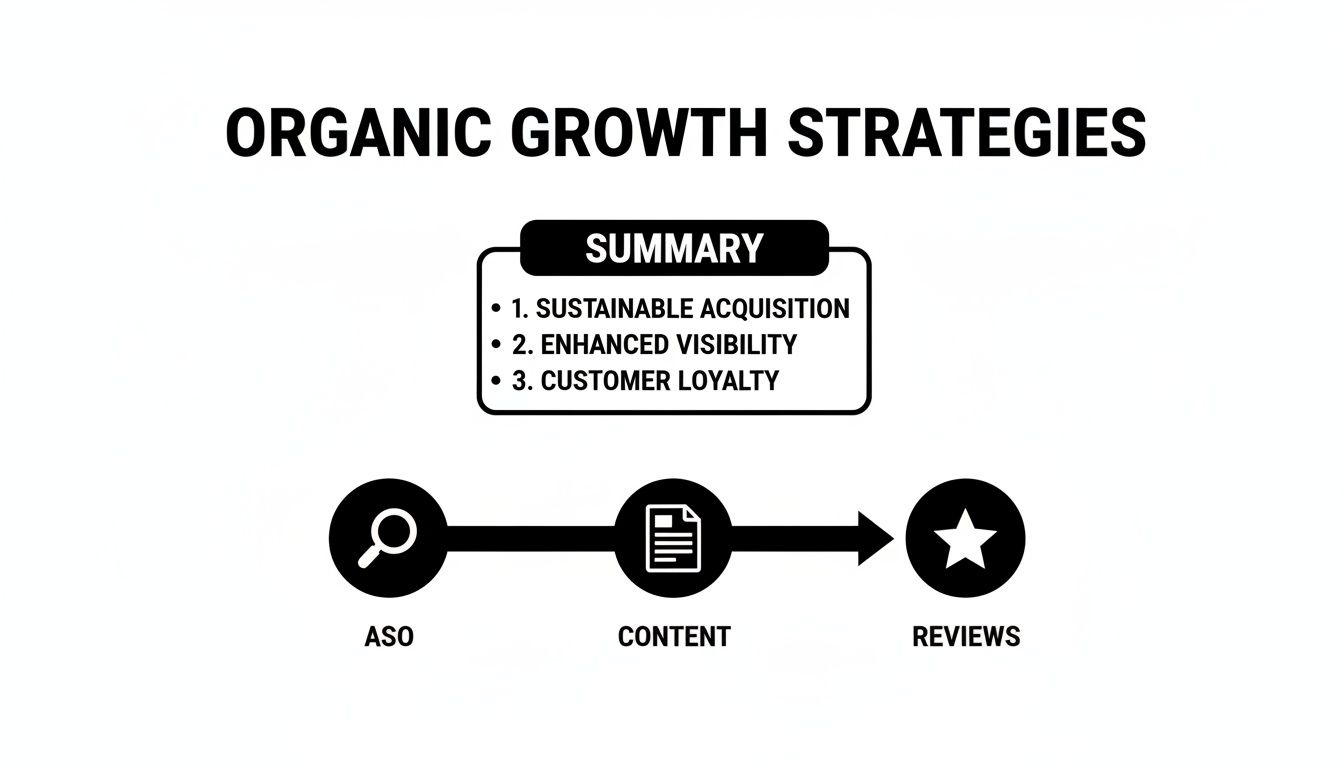
The organic growth pillars you build, like ASO, content, and reviews, will support and enhance every dollar you spend on paid campaigns, creating a powerful flywheel effect.
Recent data shows a major disconnect between where users download apps and where they actually spend money. Android often drives the most installs, but iOS frequently crushes it on revenue. One report found iOS captured 89.6% of the revenue share despite having fewer installs. This holds true across categories; in fintech, Android accounted for 83.6% of installs, but iOS users generated 63.5% of the revenue.
So, what does this mean for your strategy? On iOS, you might run campaigns optimized for in-app purchases, targeting users who are historically big spenders. On Android, you could focus on maximizing your user volume with a lower CPI, knowing you'll monetize through ads or by converting a smaller slice of a much larger user pie. If you ignore these platform differences, you're just leaving money on the table.
Building Trust with Creator Marketing and UGC
Polished, studio-quality ads still have a role to play, but let's be honest, today’s users are looking for something real. They can spot a slick, corporate ad from a mile away. This is exactly why creator marketing and User-Generated Content (UGC) have become so critical for growing a mobile app.
The whole strategy is built on a simple human truth: we trust people more than we trust brands. When a creator you follow shares their genuine excitement about an app, it feels like a recommendation from a friend. That kind of authentic endorsement cuts through the advertising noise and builds a level of credibility that a traditional ad just can't buy.
Sourcing and Vetting the Right Creators
Your first move is finding creators who actually feel like a natural extension of your brand. And I'm not just talking about follower counts. A creator with 10,000 highly engaged followers in your specific niche is almost always more valuable than someone with a million generic fans. You're searching for genuine alignment, not just empty reach.
Platforms like TikTok and Instagram are absolute goldmines for this. Start digging around with hashtags and keywords related to your app. If you’ve built a fitness app, for instance, look for creators who are already posting about home workouts, healthy recipes, or their own fitness journey.
As you vet potential partners, keep an eye out for a few key signals:
- Engagement Rate: Don't get distracted by likes. Look at the comments. Are people asking questions? Are they sharing the post? A high engagement rate is a sign of an active, loyal community that trusts the creator.
- Content Quality and Style: Does their vibe match yours? If their content is raw and hilarious but your app's brand is more polished and inspirational, the partnership might feel forced and inauthentic to their audience.
- Audience Demographics: Many creator marketplace tools provide this data, but don't be afraid to just ask the creator directly for a media kit. You need to be sure their followers actually line up with your target user.
Structuring Effective Partnerships
Once you’ve got a shortlist, it's time to figure out a partnership that makes sense for everyone. There’s no one-size-fits-all approach here. The best model really depends on your budget, your goals, and what the creator is comfortable with.
A performance-based deal is often a great place to start. This could be a cost-per-install (CPI) model where you pay a flat fee for every single download they drive. It’s a low-risk way to get started and ensures you’re only paying for real results.
As you build those relationships, you can explore other options:
- Flat-Fee Collaborations: For creators with a proven track record, a one-time fee for a specific package of content (say, two TikTok videos and three Instagram Stories) is pretty standard. This makes your costs predictable.
- Gifting and Product Seeding: For smaller creators, just sending them a free premium version of your app or some related merch can be an awesome way to get on their radar. This often leads to organic, unpaid shoutouts.
The best creator briefs I've ever seen don't read like a script. They provide key talking points, highlight the app's main value, and then give the creator the freedom to tell that story in their own voice. Trust them; they know their audience better than you do.
Turning UGC into High-Performing Ads
The magic of creator marketing doesn't stop after the first post goes live. One of the smartest things you can do is license that content and repurpose it as User-Generated Content (UGC) in your paid social campaigns. UGC just feels more native and trustworthy when it shows up in someone's feed, which often translates to higher click-through rates and lower acquisition costs.
For a deeper dive, check out our guide explaining what is user generated content and why it works so well.
Think about a gaming app. A sleek, highly produced ad showing perfect gameplay is one thing. But an ad that’s just a real TikTok creator genuinely laughing and freaking out over a surprising moment in the game? That feels far more relatable and compelling.
To pull this off, you absolutely have to secure the content rights in your creator agreement. This "whitelisting" or licensing gives you permission to run their video as an ad from your own ad account. It’s the best of both worlds: the creator's authenticity paired with the powerful targeting of a paid ad platform. This is how you build powerful social proof that strengthens your entire acquisition funnel.
Turning Acquisition into Retention and Revenue
Getting a new user to install your app is a huge win, but let's be honest, it's just the starting line. The real magic in user acquisition for mobile apps happens long after the download. This is where you turn installs into engaged users, and engaged users into a profitable, sustainable business.
A massive volume of installs looks great on a vanity dashboard, but it means very little if most of those users churn after one session. That’s why the sharpest growth teams are absolutely obsessed with the link between acquisition and retention. They know a winning strategy doesn't just bring in more users; it brings in the right users who are primed to stick around.
When you shift your focus this way, your marketing stops being a simple cost center and starts powering a genuine growth loop. By building retention into your strategy from the very beginning, you create a healthier, more valuable user base that will fuel your success for years to come.
Identifying Your Most Valuable Users
First things first: you need to get your hands dirty with post-install data. The goal is to figure out which users are driving the most value and, crucially, what they do inside your app that sets them apart. These are your most valuable cohorts.
You're looking for behaviors that have a strong correlation with long-term retention and high lifetime value (LTV). What do your best users do within their first few days or their first week?
Look for patterns like these:
- Key Feature Adoption: Do your power users gravitate toward a specific feature? For a photo editing app, maybe it's using the "background remover" tool three times in their first session.
- Session Frequency: How often are they opening the app? Perhaps your best customers for a meditation app complete at least four sessions in their first seven days.
- Social Actions: Are they inviting friends or sharing content? Actions like these are a clear sign of deep engagement and brand advocacy.
Once you pinpoint these "magic moments," you've got a crystal-clear profile of your ideal, high-value user. This profile is the blueprint you'll use to refine your entire acquisition strategy.
Your best users are a roadmap. Their early behavior tells you exactly what to look for in new users, allowing you to focus your ad spend on acquiring more people just like them.
Refining Targeting with Retention Data
Armed with these insights, you can head back to your paid channels and start sharpening your aim. Instead of optimizing campaigns for the cheapest installs possible, you can now optimize for users who are likely to perform those high-value actions you just identified.
On Meta, for example, you can build lookalike audiences from a list of users who completed a key in-app event, not just from everyone who installed. In Google App Campaigns, you can shift your bidding strategy to target a specific cost-per-action (CPA) for a first purchase or a subscription.
This data-driven feedback loop ensures your marketing dollars are spent attracting users who look and act like your current best customers. It's a direct line from retention insights back to smarter, more profitable acquisition.
Optimizing the First User Experience
You also need to give new users a gentle nudge toward those valuable actions as quickly as you can. A seamless, intuitive onboarding experience isn't a nice-to-have; it's non-negotiable for boosting early retention rates.
Your onboarding shouldn't be a generic tour of every single button and feature. It needs to be a personalized journey that guides each user straight to their "aha!" moment. If your data shows that users who create their first project on day one are 50% more likely to stick around, then your onboarding should be laser-focused on making that happen.
Well-timed push notifications can be a game-changer here, too. A simple notification can prompt a user to finish a crucial setup step or highlight a valuable feature they haven't discovered yet. This kind of proactive guidance can dramatically increase the number of users who become fully activated and engaged.
This retention-first mindset is becoming even more crucial as AI reshapes the acquisition landscape. Apps using AI-powered strategies are seeing 143% higher user growth, according to some reports. These sophisticated platforms can analyze hundreds of signals to predict which users will become high-LTV customers, enabling a level of targeting precision that's simply impossible to do manually. If you want to dive deeper into this trend, you can explore detailed findings on AI's impact on app growth.
Key Retention Metrics to Track
To truly understand if your efforts are paying off, you need to track the right metrics. These numbers tell the story of user engagement and satisfaction over time.
Tracking these metrics gives you a clear picture of your app's health and helps you pinpoint exactly where you need to focus your efforts to build a loyal user base.
Common Questions on Getting Your First Users
Even the most buttoned-up user acquisition plan will leave you with some lingering questions. It's totally normal. I've seen countless founders and marketers hit the same roadblocks when trying to nail down their budget, pick the right channels, or just figure out if what they're doing is actually working.
Let's cut through the theory and tackle some of the most common questions I hear. My goal here is to give you straightforward, battle-tested advice so you can move forward with confidence.
How Much Should I Actually Budget for User Acquisition?
There's no single magic number here, but the best way to think about it is through the LTV to CPA ratio. The gold standard you're aiming for is 3:1. In simple terms, for every dollar you spend to get a new user, you want them to eventually be worth at least three dollars to your business.
So, how do you turn that into a real-world budget? You have to work backward.
- Carve out a test period. Give yourself 30 to 90 days to just learn. Don't worry about profitability yet.
- Set a daily conversion goal. You need enough data to make good decisions. A solid baseline to aim for is at least 100 key actions per day, whether that's a sign-up, a trial start, or a purchase.
- Do the math. Multiply your target CPA by that daily conversion goal. That’s your daily test budget.
Let's say your target Cost Per Acquisition (CPA) for a new sign-up is 5.00**. To get **100 sign-ups** a day for a statistically sound test, you’d need a daily budget of **500. This approach anchors your spending in a clear learning objective, which is far smarter than just throwing money at the wall.
Which Acquisition Channel Should I Tackle First?
For almost every new app I've worked with, the answer is Apple Search Ads (ASA). It’s a no-brainer. Think about it: you're catching people at the exact moment they're on the App Store, actively searching for an app just like yours. The intent couldn't be higher.
ASA gives you a fantastic baseline. Once you have that humming, your next move is usually Meta (Facebook and Instagram). Its targeting is second to none, letting you get your creative in front of very specific types of people. After you’ve built a predictable stream of users from Meta, then you can start looking to scale bigger with channels like Google App Campaigns and TikTok.
My rule of thumb is to always start with the channel closest to the point of conversion. You get the fastest feedback on your messaging and App Store page, and you can use those early learnings to make your campaigns on broader platforms much more effective from day one.
How Long Does It Take to Actually See a Return on Ad Spend?
Getting to a positive Return on Ad Spend (ROAS) is a marathon, not a sprint. It almost never happens right out of the gate. You absolutely have to plan for an initial phase where your only goal is gathering data.
Here's a timeline I've seen play out time and time again:
- Months 1-2 (The Learning Phase): You're testing everything: audiences, creative, platforms. Your job is to find out what works, not to be profitable. Be prepared to operate at a loss here. This is your investment in data.
- Months 3-4 (The Optimization Phase): Now you take what you've learned and start making smart moves. You’ll refine your targeting, kill the losing ads, and put more budget behind the winners. Your CPA should start dropping, and you’ll inch closer to breaking even on your ad spend.
- Month 5+ (The Scaling Phase): You've found a formula that works. Now, the game is about carefully increasing your budget while keeping that ROAS positive. This is where real growth happens.
Patience is the secret weapon. If you treat those first few months as an investment in intelligence, you'll end up building a much more profitable and sustainable acquisition machine for the long haul.
Ready to build a repeatable, scalable growth engine for your mobile app? Adworkly combines expert human strategy with powerful AI to design viral distribution systems, produce high-converting creative, and orchestrate campaigns that deliver results. Learn how we get customers on autopilot.