
 UGC Infra
Tik Tok UGC: The TikTok UGC Strategy for App Growth
Boost app installs with tik tok ugc strategies. Learn to source creators, craft briefs, and measure impact for lower CPAs.
TikTok UGC is simply original video content made by actual TikTok users that features your app. Instead of coming from your brand's marketing team, it's created by the very people you want to reach. This kind of authentic content is a goldmine for app growth because it serves as powerful social proof, building trust and driving installs far more effectively than glossy, traditional ads ever could.
Why TikTok UGC Is Your App's Secret Growth Engine
If you're trying to grow an app, you're already familiar with the struggle to cut through the noise. Users are tired of disruptive, salesy ads and have become incredibly skeptical. This is exactly where TikTok UGC flips the script. It’s not just some passing trend; it has become a fundamental performance channel for scaling user acquisition.
The magic of TikTok UGC is its authenticity. When a potential user scrolls through their feed and sees a real person genuinely using and enjoying your app, it just hits differently. That peer-to-peer endorsement carries so much more weight than a polished brand message ever could.
This raw, believable validation is what convinces people to take action. It's the digital version of a friend grabbing your phone to show you a must-have app. When you can replicate that effect at scale, you turn creator content into a reliable engine for sustainable growth.
The Numbers Don't Lie
The move toward UGC isn't just based on a gut feeling; the performance data is crystal clear. On TikTok, UGC is reportedly 22% more effective than typical branded videos.
And this isn't just about views and likes. It directly impacts the bottom line. Brands incorporating UGC into their marketing mix often see a 9% lift in web conversions. For app marketers, that's concrete proof that a creator-led strategy isn't a gamble. It's a data-backed investment.
By tapping into the creativity and credibility of real users, you build a content flywheel that feels less like advertising and more like a genuine community conversation. This is the key to unlocking sustainable, cost-effective growth on the platform.
How UGC Directly Fuels App Growth
A solid TikTok UGC strategy does more than just get your name out there; it directly moves the needle on the key metrics that matter most for your app's success. It's all about measurable results.
A well-executed UGC campaign has a ripple effect across your most important performance indicators. Let's look at how it drives tangible results.
UGC Impact on Key App Metrics
The authentic, native feel of creator-made videos leads to higher engagement and lower user resistance. Here’s a quick summary of how that translates into real-world app metrics.
Ultimately, a strong UGC program creates a positive feedback loop. Better creative leads to better performance, which allows for more budget to be allocated to what's working, further fueling your growth. It’s a powerful cycle.
Breaking Down the Core Benefits
Let’s dig a bit deeper into why this works so well for apps.
- Lowering Cost Per Install (CPI): UGC blends in seamlessly with a user's For You Page. Because it resonates so well, ad platforms often reward it with better reach at lower costs. Higher click-through rates naturally lead to a more efficient cost per install.
- Improving Conversion Rates: Trust is the ultimate conversion currency. UGC answers the silent question every potential user has: "Is this app actually good? Do people like me use it?" Seeing that validation is often the final push someone needs to hit the download button and even make their first in-app purchase.
- Increasing User Trust and Authenticity: Polished ads often create a sense of distance. UGC closes that gap by showing your app in real-world contexts, used by real people. This makes your brand feel more grounded and trustworthy. If you want to learn more, our guide on what user-generated content is explains why it connects so deeply with modern audiences.
Laying the Groundwork for Your TikTok UGC Campaign
Jumping into a TikTok UGC campaign without a solid plan is a classic mistake. It's a bit like trying to build an app without a wireframe. You might end up with something, but it almost certainly won't drive the growth you're looking for. A strong foundation is what turns creator content from a fun experiment into a predictable, scalable engine for user acquisition.
This groundwork isn't about creating some massive, complicated strategy document. It’s simply about making a few smart decisions upfront that will shape everything that follows, from the creators you work with to the ads you ultimately run. Honestly, spending a little time here saves you a ton of headaches (and wasted budget) down the line.
First Things First: Define Your Campaign Goals
Before you do anything else, you have to know what you're trying to accomplish. What does a "win" actually look like for your app right now? This is crucial because the goals for a brand-new app are worlds apart from those of an established player. Vague targets like "get more installs" are useless; you need specific, measurable goals.
Your best bet is to tie your goals directly to your app's current stage of growth.
- Early Stage (Pre-Launch or <10k Users): Here, it's all about validation and getting initial traction. You need to prove that your message works and that you can acquire users at a reasonable cost. A great goal would be hitting a specific number of installs at a target Cost Per Install (CPI) to confirm your acquisition model is viable.
- Growth Stage (10k - 100k Users): Now the game shifts to scaling and optimizing what works. Your goal might be something like lowering your blended CPI by 20% or boosting your install-to-purchase conversion rate by testing out different types of creators and creative angles.
- Mature Stage (>100k Users): At this point, you're likely thinking bigger. The focus might be on brand building or expanding into new markets. You could set goals around increasing brand-related search volume or launching campaigns aimed at a new demographic, which you'd measure through audience analytics.
Setting a clear, stage-appropriate goal is the single most important thing you can do. It’s what elevates your campaign from a creative shot in the dark to a measurable business driver.
When your goals are aligned with your app's journey, every piece of UGC you commission has a clear purpose. This focus is what prevents you from burning through your budget on content that doesn't move the needle.
Pinpoint Your Ideal Creator and User Persona
Okay, you know what you want to achieve. Now, who are you talking to? One of the most common pitfalls I see is brands trying to appeal to everyone. Don't do it. You need to get laser-focused on a specific user persona and then find the right creator archetype who can genuinely connect with them.
Start by sketching out a simple profile of your ideal user. What keeps them up at night? What problems are they trying to solve? What kind of TikToks are already in their feed? For a language-learning app, your persona might be a college student dreaming of studying abroad, who already follows travel vloggers and educational accounts.
Once that persona is clear in your mind, you can find a creator who fits the bill.
- The Problem-Solver: This creator builds their platform on helping people with a specific issue. For a budgeting app, this is your go-to personal finance creator who's already sharing money-saving hacks.
- The Aspirational Figure: This person embodies the lifestyle or outcome your app helps create. A fitness app, for example, could team up with an athlete who shows exactly how the app is integrated into their elite training routine.
- The Relatable Peer: This creator feels more like a trusted friend than an "influencer." Their content is often less polished, more raw, and feels incredibly authentic. Their recommendation for a social or gaming app comes across as a genuine tip, not a paid ad.
When you match the creator archetype to your user persona, the message just lands better. It feels natural, not forced.
Understand the Different UGC Approaches
Not all UGC is created equal, and the path you take really depends on your goals, budget, and how much control you want to have. There are three main ways to approach getting content for your campaign.
For most apps just starting out, a hybrid approach works wonders. You can begin with a few small paid partnerships to generate your first batch of videos. Once you spot a winner, a video that's getting great engagement and clicks, you can whitelist it and put ad spend behind it. This turns a single great organic post into a powerful user acquisition machine, giving you the best of both worlds: authenticity and scalable performance.
How to Find and Partner With the Right Creators

The success of your entire TikTok UGC campaign really boils down to one thing: the creators you choose to work with. Finding the right talent is what separates a video that gets lost in the noise from one that drives thousands of app installs.
But sourcing creators shouldn't feel like an endless scroll through your For You Page. You need a solid, repeatable system for finding, vetting, and onboarding partners who are a perfect fit for your app.
This is about so much more than follower count. The best partnerships are built on a foundation of genuine brand fit, audience alignment, and a crystal-clear understanding of your goals. Honestly, a creator whose audience is a mirror image of your ideal user is infinitely more valuable than some mega-influencer with a broad, un-engaged following. The key is to be methodical.
Smart Ways to Source TikTok Creators
Forget about aimless searching. The most efficient way to find great creators is by using a mix of targeted strategies that bring top-tier talent right to your doorstep. This approach ensures you find both established creators and those hidden gems who are just about to blow up.
Here are a few paths you can take to build your roster:
- Manual Hashtag Research: Go deeper than the obvious tags. Get hyper-specific with hashtags related to your app’s niche. Think
#booktokrecommendationsfor a reading app or#mealprephacksfor a nutrition app. This is how you find people who are already passionate and creating content in your world. - Competitor Analysis: Take a peek at who your competitors (or even brands in similar spaces) are working with. Not only can this uncover some great potential partners, but it also gives you a ton of insight into what kind of content is already clicking with your target audience.
- Creator Marketplaces: Platforms like Upwork, Collabstr, or other dedicated UGC marketplaces were literally built for this. They can save you a massive amount of time, letting you filter creators by niche, audience demographics, and rates to really zero in on the right people.
Using these methods helps you build a strong pipeline of potential partners, shifting you from a reactive search to a proactive sourcing machine.
Your Essential Creator Vetting Checklist
Okay, so you’ve got a list of potential creators. Now comes the most important part: vetting. This is where you avoid bad partnerships and make sure your investment is going to pay off. A quick glance at their follower count just won't cut it.
You have to dig in to understand the real health and relevance of their account. Here’s a practical checklist to run through:
- Audience Demographics: Do their audience's age, location, and interests actually line up with your ideal user? Their content might look perfect, but if their followers aren't your target market, the campaign is dead on arrival.
- True Engagement Rate: Look past the vanity metrics. Calculate their real engagement rate: (Likes + Comments + Shares) / Followers x 100. On TikTok, a healthy rate is generally around 3-5%. Just as important, read the comments. Are they just "nice video!" or are people having real, thoughtful conversations?
- Content Authenticity and Brand Fit: Scroll through their last 20-30 videos. Is their style authentic? Do their values seem to align with your brand's? If you see them promoting a different app every other day, their recommendations might not feel very genuine to their audience.
- Past Performance: Don't be afraid to ask for a "portfolio" of past brand collaborations. You want to see creators who can talk about the results they've driven, not just the videos they've made.
This vetting process helps you find creators who aren't just popular, but who can produce tik tok ugc that actually moves the needle for your app.
Finding the right creator is a matchmaking process. You are not just buying a video; you are borrowing trust. Ensure the creator has built a genuine, engaged community that aligns perfectly with the users you want to attract.
Structuring Fair and Motivating Compensation
How you pay creators really sets the tone for the entire partnership. The best payment models are fair, transparent, and directly tied to what you want to achieve with the campaign.
There are a few common ways to structure deals:
- Flat Fees: This is the most straightforward approach. You pay a fixed price for a set number of videos. It's great for keeping your budget in check and is often preferred by creators because it guarantees their income.
- Performance-Based Payouts: This model links pay directly to results, like app installs or clicks. While it can be very cost-effective for you, it puts all the risk on the creator. This can be a tough sell unless you have a high-converting offer and a strong brand reputation.
- Product Seeding: If your app has a subscription, offering a free lifetime or annual plan can be a fantastic way to partner with micro-creators or just get your foot in the door. This is often paired with a smaller flat fee to sweeten the deal.
To really get this right, you need to understand the ins and outs of these partnerships. For a deeper dive, check out our guide on TikTok influencer marketing to build stronger, more effective collaborations. By sourcing smart, vetting carefully, and offering fair compensation, you'll build a network of creators who become true champions for your app.
How to Craft a Creative Brief That Actually Inspires Great Content
Let’s be honest: your creative brief is the single most important document you'll create for your TikTok UGC campaign. It’s the handshake between your app’s growth goals and a creator’s unique voice. A flimsy brief? Get ready for off-brand content, painful revision cycles, and a budget that vanishes with little to show for it. But a great brief? That’s how you inspire creators to produce authentic, high-performing videos that people actually want to watch.
The point isn't to storyboard every single second of their video. Far from it. The goal is to provide clear direction and essential guardrails, then get out of the way so the creator's personality can take over. This balance is the secret sauce to genuine tik tok ugc that resonates with real people and, most importantly, drives installs.
The Anatomy of a Perfect Brief
Think of your brief as a quick, scannable guide. A creator should be able to grasp exactly what you need in just a few minutes, without getting bogged down in corporate jargon. I like to think of it as a recipe. You provide the core ingredients and the main steps, but the creator is the chef who adds their own spice and flair.
Here are the absolute non-negotiables every UGC brief needs to nail right from the start:
- Campaign Objective: You have to start with the "why." Are you trying to drive app installs, show off a cool new feature, or just get your name out there? Be super specific. For instance, "Drive downloads for our new meal-planning app from US-based users aged 22-30."
- Core Message: If the viewer only remembers one thing, what should it be? Boil it down to a single, powerful sentence. For a finance app, it could be something like, "This app makes it insanely simple to track your subscriptions so you can stop wasting money."
- Target Audience: Give a quick sketch of who you're trying to reach. This helps the creator adjust their tone and language. Something like, "We're talking to busy college students who are overwhelmed and struggling to stay organized."
This initial context is everything. It makes sure the creator understands not just what to make, but why they're making it.
Finding the Balance: Must-Haves vs. Creative Freedom
This is where the magic really happens, balancing your brand's needs with the creator's creativity. You have to be crystal clear about the things that must be included, but you also have to give them room to be themselves. Overly restrictive briefs are the fastest way to kill the authenticity that makes UGC so powerful in the first place.
The best briefs I've ever seen provide a clear destination but let the creator choose the route. Give them the key talking points and brand rules, then trust them to deliver that message in their own style.
One of the most effective ways to do this is with a simple "Do's and Don'ts" table. It’s impossible to misinterpret and sets clear boundaries without being a control freak.
Do's and Don'ts Example for a Fitness App:
See how clean that is? It's easy to scan and leaves zero room for confusion. You get the critical elements you need for the ad to work, and the creator gets to focus on the fun part: making a great video.
Providing Clear Visual and Audio Direction
Finally, you need to paint a picture of the look and feel you're going for without handing them a word-for-word script. This part is all about sparking inspiration, not barking orders.
I always find it helpful to include:
- Video Concept Ideas: Give them 2-3 starting points to get their wheels turning. For a language app, you could suggest: "A 'day in the life' showing how you sneak in lessons on your commute," or maybe, "A satisfying before-and-after of your progress after just one month."
- Key Features to Highlight: Don't just say "show the app." Get specific. For example: "Please show yourself setting up a new budget in the 'Budgeting' tab and make sure to highlight the colorful category breakdown chart."
- Call-to-Action (CTA): This can’t be vague. Tell them exactly what to say and what text to put on the screen. Something like, "Verbally say 'Tap the link in my bio to download for free' and add a text overlay that says 'Download for Free'."
When you break your brief down into these simple, manageable parts, you’re setting your creators up for success. You get content that actually hits your marketing goals, and they get to make a video that feels true to their audience. It's a win-win, and that collaborative spirit is the foundation of every truly great TikTok UGC campaign.
How to Measure and Optimize Your UGC Campaigns
Getting your TikTok UGC campaign live is just the first step. The real magic, and the growth, happens when you stop guessing and start measuring. If you’re not tracking performance, you’re flying blind. You have no idea which creator, video, or hook is actually convincing people to install your app.
A solid analytics and optimization loop is what turns your UGC from a creative expense into a predictable growth engine. It’s all about creating a feedback system where data from your live campaigns directly informs your next move. This is how you learn what truly resonates with your audience, letting you double down on what works and kill what doesn't. This constant cycle of improvement is the key to scaling user acquisition without burning through your budget.
This whole process really starts with the creative brief. A well-structured brief doesn't just guide creators; it sets the stage for content that's built to be measured from day one.
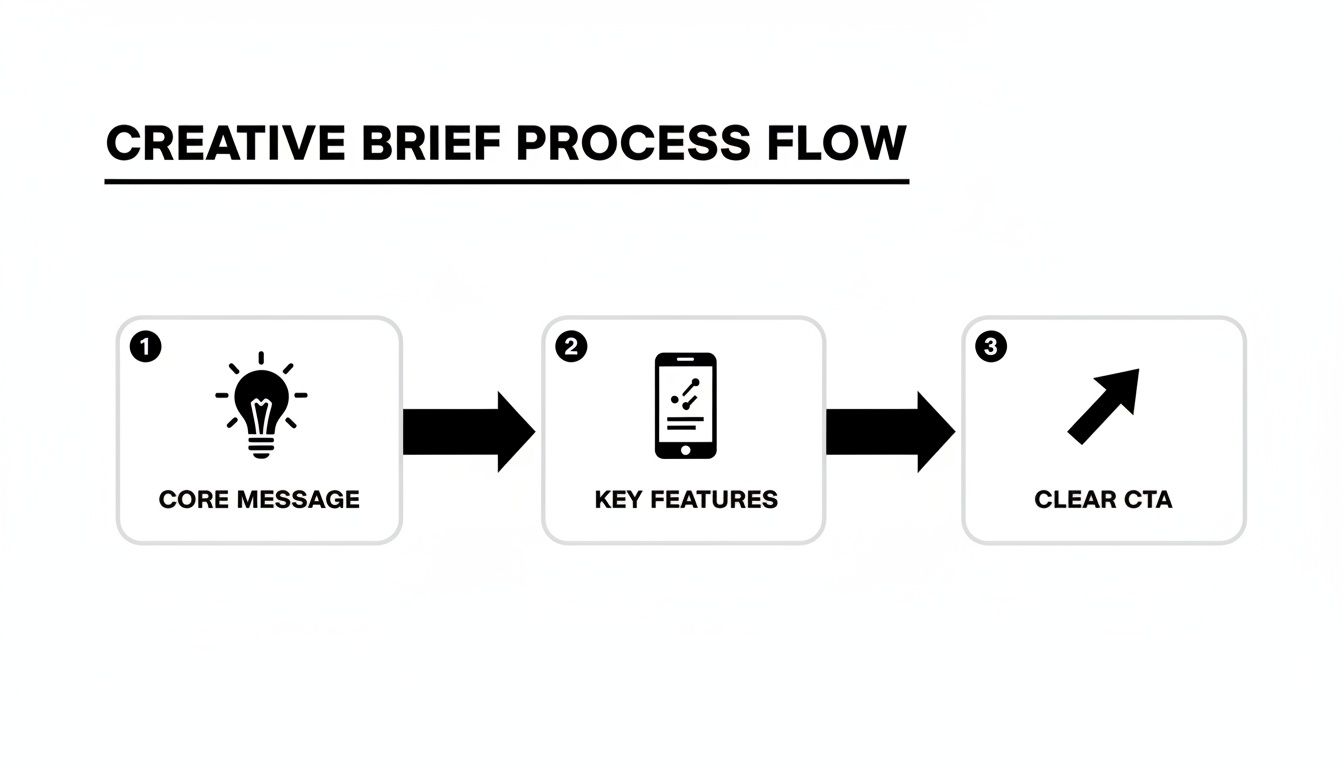
When you arm creators with a clear core message, specific features to highlight, and a strong call-to-action, you’re not just hoping for good content. You’re engineering it for performance.
Defining Your Key Performance Indicators
Before you can measure success, you have to define what it looks like. Your Key Performance Indicators (KPIs) need to map directly to your user acquisition funnel, giving you a clear window into performance at every single stage. Relying on just one or two metrics is a mistake; you need a mix of top-funnel and bottom-funnel data to see the full picture.
Tracking the right metrics is fundamental. Below is a breakdown of the most important KPIs to monitor at each stage of the funnel.
Essential KPIs for TikTok UGC Campaigns
Monitoring these KPIs gives you a comprehensive view of your campaign's health, from initial impression to final conversion. This data is the foundation for all your optimization decisions.
Attribution Is Non-Negotiable
Here’s where a lot of campaigns fall apart: attribution. Without it, you have no way of knowing which specific creator or video is driving your app installs. You're left guessing.
Setting up a reliable tracking system is the only way forward. The most straightforward and effective method is using UTM parameters and unique tracking links for every single creator. This allows your mobile measurement partner (MMP) or analytics platform to trace an install right back to its source.
You can’t optimize what you can’t measure. Assigning a unique, trackable link to every creator is the only way to get the granular data you need to make smart decisions about where to put your budget.
This level of detail is a complete game-changer. Suddenly, you can confidently identify your top-performing creators and creative angles, giving you a clear roadmap for what to do next. For a more detailed look at this, our guide on TikTok creator analytics goes even deeper into performance tracking.
Turning Winners Into Paid Ads
One of the smartest plays in the tik tok ugc playbook is to find your best-performing organic videos and pour gasoline on the fire with a paid budget. This strategy perfectly blends the raw authenticity of UGC with the precision targeting and massive scale of paid advertising.
When an organic video takes off with high engagement and a solid CTR, it's already proven itself in the wild. Instead of trying to build a new ad from scratch, you can use TikTok’s Spark Ads feature to promote that exact video as a paid creative. It works so well because it feels native to the For You Page, piggybacking on the creator’s credibility and the video’s built-in social proof.
This lets you put rocket fuel on what’s already working. From there, you can A/B test different hooks, captions, or CTAs to squeeze every last drop of performance out of your best content, turning a single viral video into a scalable user acquisition machine.
Avoiding Common Traps and Staying Above Board
Look, I've seen a lot of app founders get excited about UGC campaigns, only to make a few common and costly mistakes right out of the gate. It's easy to fall into these traps if you're not careful.
One of the biggest blunders is micromanaging creators. You hire them for their authentic voice, then try to script every single word. It never works. It just kills the vibe and makes the content feel stiff and fake. On the flip side, some founders expect every single video to be a viral sensation, which is just an unrealistic expectation that sets everyone up for failure.
But the most dangerous mistake? Not getting your content usage rights locked down. You could get an absolute banger of a video, but if you don't have the right permissions, you can't legally touch it for paid ads or anything else. This is a huge legal headache waiting to happen and torpedoes the ROI on your best creative.
Getting Your Legal Ducks in a Row: Usage Rights and Contracts
This is where the paperwork really matters. A handshake deal or a quick DM exchange just won't cut it when it comes to TikTok UGC. You absolutely need a clear, written agreement with every single creator you work with.
Think of this as non-negotiable protection for your brand.
Your creator contract is your safety net. It needs to spell out, in no uncertain terms, who owns the content, for how long you can use it, and on which platforms. Any gray area here is just asking for a dispute down the road.
A solid contract doesn't just prevent arguments; it gives you the legal freedom to scale your best-performing content across all your marketing channels. Skipping this step is one of the fastest ways to derail a promising campaign.
A No-Nonsense FTC Compliance Checklist
Beyond contracts, you've got to play by the rules. The Federal Trade Commission (FTC) has clear guidelines about disclosing paid partnerships, and ignoring them is a bad look that can cost you. It erodes trust with your audience and can lead to some hefty fines.
Here’s a simple checklist to keep your campaigns compliant and your brand's reputation intact:
- Insist on Clear Disclosures: Make sure your creators use obvious hashtags like #ad, #sponsored, or #BrandPartner. They need to be front and center in the video caption, not buried in a sea of other tags.
- Educate Your Creators: Never assume creators know the ins and outs of FTC rules. A quick line in your creative brief and contract explaining the why behind disclosures goes a long way.
- Quickly Review Before Posting: Before any sponsored video goes live, just do a quick spot-check. Is the disclosure there? Is it visible? It takes two seconds and can save you a world of trouble.
Following these simple legal steps protects your app, builds genuine trust with your audience, and keeps your campaigns running without a hitch.
Your TikTok UGC Questions, Answered
Diving into TikTok UGC for the first time? It's natural to have questions. Let's clear up some of the most common ones we hear from app founders gearing up for their first campaign.
Do I Really Need a Huge Budget to Get Started?
Absolutely not. It's a common misconception that you need a massive budget to make a splash. In reality, you can get incredible results by starting small and being smart about it.
A great way to begin is by collaborating with a handful of micro-creators. These creators often have super-engaged, niche audiences and their rates are much more approachable than the big-name influencers. Another fantastic low-cost strategy is product seeding, which means offering creators free premium access to your app in exchange for a video. This keeps your initial cash outlay low while you build up a library of authentic content to test.
What’s the Real Difference Between UGC and Influencer Marketing?
This one causes a lot of confusion, and it's easy to see why the lines feel blurry. The core difference really comes down to intent and asset ownership.
Think of traditional influencer marketing as a paid endorsement. You're paying a creator with a big following to promote your app to their audience. It's about renting their reach for a moment in time.
TikTok UGC, on the other hand, is all about the style of the content. It’s authentic, user-centric creative that looks and feels like it was made by a genuine fan, even if you paid for it. The primary goal isn't just a post on their feed; it's to generate powerful creative assets that you own and can use in your own paid ad campaigns, like through TikTok's Spark Ads.
Here's the simplest way to put it: With influencer marketing, you're renting an audience. With a UGC campaign, you're commissioning authentic creative you can use to scale your own advertising.
How Many Creators Should I Start With?
It's tempting to go wide, but for your first campaign, focus is your friend. Don't spread yourself too thin.
We've found the sweet spot is partnering with three to five creators to start. This gives you enough creative variety to see which messaging angles, creator styles, and video formats actually resonate with your target audience. Any more than that, and it can quickly become a logistical headache.
Once the initial videos are live and you have some performance data, you can pinpoint what's working. For example, you can see which creator archetype is driving the lowest Cost Per Install (CPI), and then double down on that for your next batch of content.
Ready to build a scalable user acquisition engine with authentic creator content? Adworkly combines expert strategy with AI-powered execution to launch and optimize high-performing TikTok UGC campaigns that drive real app growth. Learn how we can lower your CPA and boost conversions at adworkly.co.