
 UGC Infra
How to Reduce Customer Acquisition Cost a Founder's Guide
Discover how to reduce customer acquisition cost with our founder's guide. Learn proven strategies for optimizing channels, boosting LTV, and leveraging AI.
Let's be real. Watching your Customer Acquisition Cost (CAC) creep up is one of the most stressful things a founder can experience. It feels like you're just lighting money on fire, with less and less to show for every dollar you push into your ad budget. If this sounds familiar, you're not alone. The old growth playbooks just aren't cutting it anymore.
The market is more crowded and complicated than ever, and acquiring new users has gotten painfully expensive. It's not just a feeling; the numbers back it up. Intense competition on the big ad platforms, coupled with major privacy shifts, has completely rewritten the rules of the acquisition game.
The Sobering New Reality of Acquiring Users
Picture this: you're running ad campaigns and find out you’re losing 29** for every single new customer you bring in. It sounds wild, but that was the tough reality for many brands back in 2022, a massive jump from losing just **9 per customer in 2013. That's a staggering 222% spike.
This data, highlighted in this insightful report on rising customer acquisition costs, shows how out-of-control ad prices on platforms like Meta, Google, and TikTok have become. Simply throwing more money at ads isn't just inefficient; it's a recipe for disaster. Success today demands a much smarter, more sustainable strategy.
This guide is designed to be your roadmap. We’re going to build that efficient growth engine together.
The goal here isn't a quick, temporary fix. It’s about building a resilient acquisition system that can handle market shifts and drive profitable, long-term growth.
Before we dive deep, here’s a quick overview of the key strategies we'll be covering. Think of this table as a high-level summary of the levers you can pull to start making a real impact on your CAC.
Key Levers for Reducing Your Customer Acquisition Cost
This table gives you a snapshot of our game plan. Each of these areas represents a powerful opportunity to not only cut costs but also to build a more robust and profitable business.
Now, let's get into the specifics. This isn't just theory; it's an actionable plan for modern app founders and growth teams who are tired of watching their acquisition costs spiral. We're going to get our hands dirty.
Get Your Bearings with a Full-Funnel Audit
You can't fix what you can't measure. Before you can dream of lowering your customer acquisition cost, you have to know what it is right now. You need to know it for real.
Too many teams fall into the trap of using a back-of-the-napkin formula: total ad spend divided by new customers. It feels simple, but it's dangerously misleading. This approach glosses over the real, fully-loaded cost of bringing a user into your ecosystem.
To get an accurate baseline, you need to dig deeper and account for every dollar that goes into acquisition. Think beyond just the ad spend. We're talking about the salaries of your marketing and sales folks, the cost of producing that slick new video creative, and the subscriptions for your analytics tools, CRM, and automation platforms.
When you do this, your CAC transforms from a fluffy marketing metric into a hard financial truth.
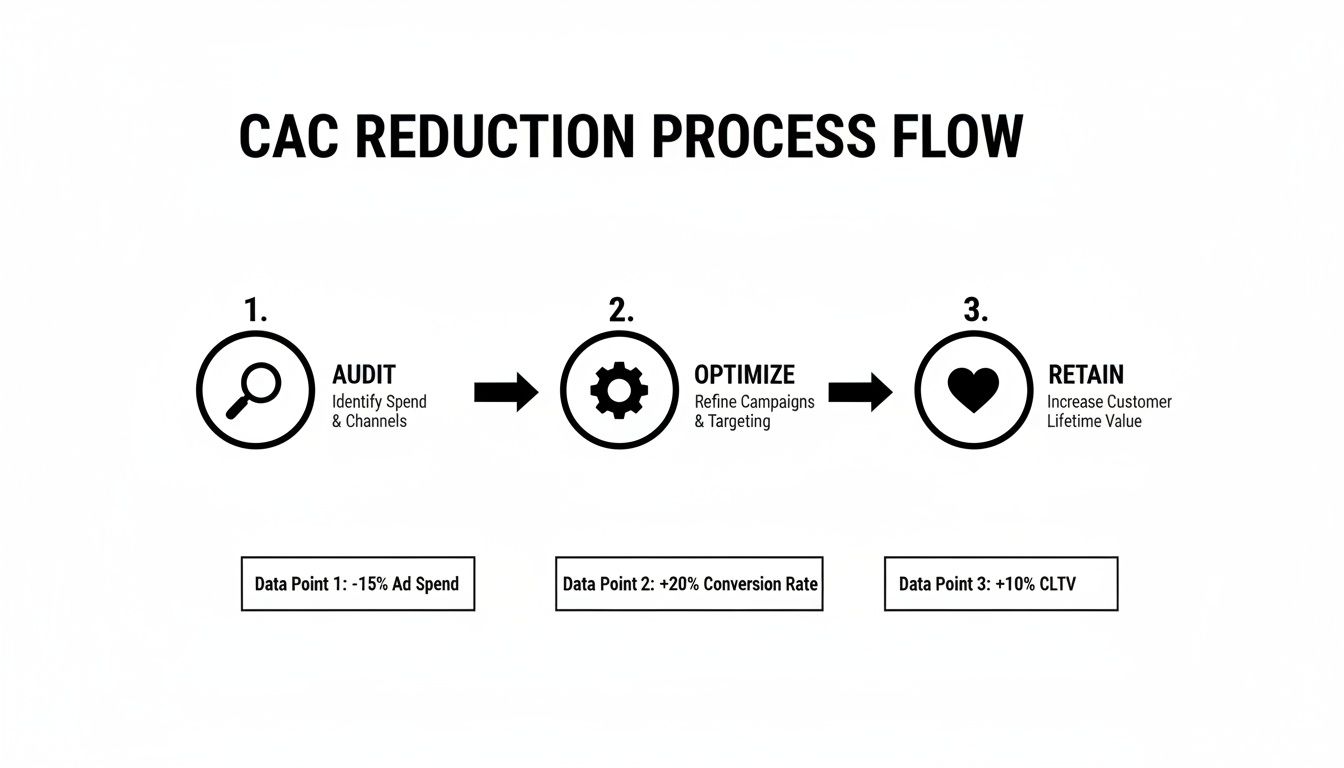
The process laid out here isn't a one-and-done project. It’s a continuous loop. Auditing gives you the data to optimize, and optimizing frees up resources to focus on retention. Retention in turn makes every dollar you spend on acquisition go further.
Instrument Every Stage of the Funnel
With your total costs in hand, the next move is to map them to the specific stages of your acquisition funnel. This is where you graduate from only looking at the final conversion to tracking the critical micro-conversions that happen along the way. Your mission is to understand the cost at each and every touchpoint.
For an app founder, this means getting obsessive about metrics like:
- Cost Per Click (CPC): The raw cost for every ad click.
- Cost Per Install (CPI): What you pay for a user to actually download and install the app.
- Cost Per Activation: The true expense to get a new user to take that first meaningful action, like completing the tutorial or creating a profile.
Breaking down costs this way gives you an X-ray view of your funnel's health. You can see precisely where users are dropping off and where your costs are ballooning. This is the raw data you need to make surgical, high-impact optimizations instead of just guessing.
Calculating Your True Customer Acquisition Cost
Okay, you've tallied your expenses and mapped your funnel. Now you can calculate your true CAC. The formula isn't complicated, but its accuracy depends entirely on the quality of the data you've just gathered.
Let's look at a real-world example. Imagine a gaming app spent $50,000 last month on acquisition efforts. That breaks down into:
- $35,000 on direct ad spend across Meta, TikTok, and Google.
- $10,000 in prorated salaries for the growth marketing team.
- $5,000 for new creative assets and various marketing software subscriptions.
During that month, they brought in 10,000 new users who made their first in-app purchase. Their true CAC isn't just based on ad spend; it's **5.00** per paying user (50,000 / 10,000).
To get a handle on your own numbers, plugging them into a customer acquisition cost calculator can provide instant clarity and help you model different scenarios.
Segment Your CAC to Find Actionable Insights
A single, blended CAC number is a decent starting point, but the real gold is in segmentation. An average CAC can hide a world of pain and opportunity. That "successful" channel might be propped up by one rockstar campaign while three others are quietly burning through your cash.
By segmenting your CAC, you move from knowing what you spend to understanding why and where that spend is most effective. This insight is non-negotiable for anyone serious about reducing customer acquisition cost.
You need to start slicing your CAC by a few key dimensions:
- By Channel: How does the CAC from Google Ads compare to TikTok? What about organic search?
- By Campaign: Drill down within a channel. Which specific ad sets or campaigns are the real winners?
- By Cohort: Group users by the week or month they were acquired. Is your CAC trending up or down over time?
- By Demographic: If you can, segment by user attributes. Are users in the US cheaper to acquire than users in the UK? iOS vs. Android?
This level of detail shines a spotlight on what's profitable and what's not. It gives you the confidence to kill the underperformers and double down on what’s working, setting the stage for a truly data-driven cost-reduction strategy.
Optimizing Paid Channels with AI and Superior Creatives
Once you’ve got a handle on your acquisition costs, it's time to make your ad spend work smarter, not just harder. The old playbook of just managing ad campaigns is dead. Today, reducing your customer acquisition cost means embracing a far more intelligent, data-driven approach to your paid channels.
The two biggest levers you can pull here are artificial intelligence and a relentless focus on creative performance. AI isn't some far-off concept. It’s a practical tool that can automate your bidding, predict who will actually buy, and personalize ads at a scale no human team could ever match.

Letting AI Drive Efficiency
Think of your typical ad campaign as casting a wide, clumsy net. Sure, you catch some of the right fish, but you also haul in a ton of junk. This wastes a huge chunk of your budget. AI completely flips this on its head. It’s more like a skilled angler, knowing exactly where the prize fish are biting.
How does it do this? Through a few critical functions:
- Predictive Lead Scoring: AI models sift through user data to pinpoint which prospects are most likely to convert and, more importantly, have a high lifetime value (LTV). This lets you aim your ad spend at users who will actually grow your bottom line.
- Dynamic Bidding: Forget setting static bids. AI algorithms adjust your bids in real-time, based on the conversion probability of every single impression. You never overpay for a low-value click again.
- Hyper-Personalized Creatives: AI can dynamically assemble ad components. It can match the perfect headline, image, and call-to-action to specific user segments for maximum impact.
The results speak for themselves. This isn't just hype; it's a CAC-killer. Businesses that have gone all-in on AI for advanced targeting and personalization are reporting up to 50% drops in acquisition costs across e-commerce, SaaS, and fintech.
Consider this: traditional Meta or TikTok ads often waste 40-60% of their budget on low-intent traffic. AI changes that entire equation with predictive scoring and personalized ads that hit the mark, time and time again.
Building a Creative Experimentation Engine
While AI handles the technical heavy lifting, your creative is what makes the human connection. It’s what actually drives someone to click. In today's ridiculously crowded ad space, "good enough" creative is basically invisible. To cut through the noise, you need a system for constant experimentation. Treat every ad like a hypothesis that needs to be proven.
This isn't about chasing one "perfect" ad that will solve all your problems. It’s about building a deep library of high-performing elements like hooks, visuals, and messages that you can mix, match, and iterate on. The goal is to relentlessly test every variable to figure out what truly clicks with your audience.
Creative performance is not a matter of opinion or luck. It's a science. The teams that win are the ones that test more, learn faster, and adapt their messaging based on real-world data, not assumptions.
Start by breaking your creatives down into their core parts and testing them methodically:
- Hooks: What’s the very first thing someone sees or hears? Test different opening lines, punchy questions, or unexpected visual scenes to see what actually stops the scroll.
- Formats: How does a raw, user-generated content (UGC) style video stack up against a polished, professionally produced spot? Test everything: static images, carousels, short-form videos, and animated graphics.
- Messages: What’s your angle? Are you leading with features? Benefits? A specific pain point? Or social proof? Test different value props to see which one drives the most action.
Sourcing and Testing High-Impact Creatives
To keep your experimentation engine humming, you need a constant flow of fresh creative assets. Don't box yourself in with just in-house production. You need to tap into different sources to keep your content feeling authentic and relevant.
1. User-Generated Content (UGC) Get your actual customers involved. Run a contest, offer some perks, or just reach out to your power users and ask them to create content with your app. UGC feels far more trustworthy and relatable than slick branded content, which almost always leads to higher engagement and lower costs.
2. Influencer and Creator Partnerships Team up with creators who genuinely align with your brand. Just as importantly, give them the creative freedom to make content in their own unique style. An authentic endorsement from a trusted creator can be an incredibly powerful way to build social proof and drive high-quality installs.
3. Programmatic and In-House Ads Keep producing your own ads, but be smarter about it. Use the data from your UGC and creator tests to inform your concepts. If a specific hook from an influencer’s video is crushing it, adapt that idea into a programmatic ad and scale it across platforms like TikTok and Instagram. This data-driven approach to creative is a cornerstone of modern growth. For a deeper dive, check out our guide on leveraging AI for ad creative development.
When you combine the analytical power of AI with a robust system for creative testing, you create a powerful flywheel. AI optimizes the delivery, and your superior creative drives the conversions. Together, they ensure every single ad dollar is invested for maximum efficiency, leading to a sustainable and significant drop in your customer acquisition cost.
Scale Organic Growth with SEO and Creators
If you want to bring down your CAC for good, you need to build channels that don't come with a per-click price tag. Paid ads are great for turning on the volume quickly, but they're a rental. The second you stop paying, the flow of new users dries up. True, sustainable growth comes from building assets that generate traffic and signups on their own.
This is where a solid organic growth engine becomes your most valuable player. While paid channels rent attention, organic channels earn it. This creates a competitive moat that your rivals can't just cross by throwing more money at ads. We're going to focus on two of the most powerful pillars for this: modern SEO and authentic creator-led distribution.

Modern SEO Is More Than Just Blog Posts
When founders hear "SEO," they usually think of ranking articles on Google. That’s part of the puzzle, but for an app, the definition of "search" is much broader. Your potential users aren't just on Google. They're searching for solutions directly inside the app stores and, more and more, asking AI assistants for recommendations.
A modern SEO strategy for any app has to cover all these bases:
- App Store Optimization (ASO): Think of this as SEO, but specifically for the Apple App Store and Google Play. It’s all about optimizing your app’s title, keywords, description, screenshots, and preview video to show up higher in app store search results. A sharp ASO strategy means you're capturing high-intent users right at the moment they’re looking for an app just like yours.
- Content for the AI Era: The game is changing with AI assistants and LLM-powered search. The new goal is to create clear, authoritative content that answers user questions directly. When you do this well, your app and its content become prime candidates for being featured in AI-generated summaries, positioning you as the go-to solution.
Build Real Partnerships with Creators
The second pillar here is creator-led distribution. Let's be clear: this isn't about paying a celebrity for a one-off shoutout. It’s about building genuine, long-term relationships with creators who actually connect with your product and your audience.
Authenticity is everything. People can spot a transactional, sponsored post from a mile away. The partnerships that truly move the needle are built on mutual value, where creators are free to share your app in their own voice. The result is content that feels totally natural on their feed and actually helps their followers.
Creator-led growth is about co-creation, not just promotion. When you treat creators as true partners, they become your most powerful storytellers, building social proof and trust in a way that no branded ad ever could.
Done right, a great creator program turns influential voices into a powerful extension of your marketing team, driving word-of-mouth at a massive scale.
A Playbook for Creator-Led Distribution
You can't just slide into DMs and hope for the best. Building a creator program that actually works and lowers your CAC requires a structured approach.
- Find the Right Partners: Look past the follower count. The best partners have killer engagement rates and an audience that perfectly mirrors your ideal customer. Use tools to find creators whose followers have a real, demonstrable interest in your app's category.
- Focus on Creating Value Together: Don't just send over a creative brief and a contract. Work with creators to develop content that serves their audience first. Maybe it's a tutorial, a "day in the life" video showing your app in action, or an honest-to-goodness review.
- Spark Viral Loops: Encourage content that people can't help but share. For example, a fitness app could team up with creators to launch a viral workout challenge. This not only gets the app's name out there but also gets users creating and sharing their own content, kicking off a powerful, self-sustaining cycle.
This strategy often taps into the power of user-generated content (UGC), where the line between creator and customer starts to blur. For a deep dive, our guide on a successful TikTok UGC strategy offers a playbook for turning authentic user videos into a massive acquisition channel.
By investing in SEO and creator partnerships, you stop renting traffic and start building an owned audience. It takes more upfront effort, for sure. But these channels pay dividends for years, steadily lowering your blended CAC and creating a much more resilient, profitable growth engine for your app.
Boosting Lifetime Value to Improve CAC Efficiency
Lowering your customer acquisition cost isn't just about finding cheaper ad placements. A truly effective growth strategy is a two-sided coin. It's just as much about earning more from every single user you worked so hard to get in the door. This is where customer lifetime value (LTV) becomes your most powerful lever.
When you can increase what a customer is worth to your business over time, the upfront cost to acquire them suddenly looks a lot more reasonable. A higher LTV gives you the breathing room to compete on more expensive channels, outbid rivals for premium inventory, and build a sustainable business. A sustainable business is not constantly chasing rock-bottom ad prices. It fundamentally changes the math of your growth engine.
Mastering the LTV to CAC Ratio
The entire game comes down to the relationship between what you earn from a user and what you paid to get them. This is your LTV:CAC ratio, and it's one of the most honest health metrics for any app. It tells you, point-blank, if your business model actually works.
Benchmarks will vary by industry, but a healthy LTV:CAC ratio is generally considered to be at least 3:1. For every dollar you put into acquisition, you should expect to get at least three dollars back over that customer's lifetime. If you’re hovering around 1:1, you’re just spinning your wheels. Anything less, and you're paying to give your app away.
Improving this ratio is what sustainable growth is all about. You can either obsess over pinching every last penny from your CAC, or you can focus on making users so happy they stick around and spend more. The second path is a far more durable and rewarding strategy.
Optimize Onboarding for That "Aha!" Moment
The road to a high LTV starts the second a user opens your app for the very first time. Your onboarding flow is your one shot to prove your app's value and set the tone for a long-term relationship. A clunky, confusing, or boring first run is the number one reason for day-one churn.
The goal is simple: get users to their "aha moment" as fast as possible. This is that magical point where they truly get why your app is great and how it solves their problem.
- Personalize the first few minutes: A couple of quick questions can make all the difference. A fitness app can ask about goals; a music app can ask for favorite artists.
- Show, don't just tell: Ditch the static text overlays. Use interactive tutorials and guided walk-throughs that let people learn by doing.
- Celebrate small wins: Did a user just create their first project or finish their first lesson? Acknowledge it! Positive reinforcement is a powerful tool for building momentum.
Drive Re-Engagement with Lifecycle Messaging
Okay, they’re onboard. Now the real work begins: keeping them around. A smart lifecycle messaging strategy using a mix of push notifications and email is essential here. Think of these not as marketing blasts, but as helpful, targeted nudges based on what a user has (or hasn't) done in your app.
Retention is the new growth hack. Seriously. Smart brands are pouring resources into their lifecycle strategies because acquiring a new user can cost 5 to 25 times more than keeping a current one. In a world of rising ad costs, where some fintech apps pay over $1,450 for a single customer, re-engagement isn't just a tactic. It's an economic lifeline. You can dig into more data on how brands are shifting budgets to retention on swaystack.com.
A well-oiled program can bring lapsed users back from the brink and turn casual users into your biggest fans. Here's a look at how specific tactics can move the needle.
LTV-Boosting Tactics and Their Impact
This table highlights specific retention strategies and quantifies how they contribute to a healthier LTV:CAC ratio.
By systematically nailing your onboarding and implementing a thoughtful re-engagement plan, you create a powerful feedback loop. Better retention leads to a higher LTV, which in turn makes your initial CAC far more efficient. That’s the foundation for profitable, long-term growth.
Common Questions on Lowering Your CAC
When you're deep in the trenches of growing an app, questions about customer acquisition cost are always top of mind. Let's tackle some of the most common ones we hear from founders and growth teams to give you some quick clarity.
What’s a “Good” Customer Acquisition Cost, Anyway?
This is the million-dollar question, but the answer isn't a specific number. A "good" CAC is completely relative to your Customer Lifetime Value (LTV). There's no magic dollar amount that fits everyone.
A B2B SaaS company might be perfectly happy with a 300** CAC because their average LTV is **1,200. On the flip side, a free-to-play mobile game might go out of business if its CAC creeps over $5.00. It all comes down to your business model.
The real metric to obsess over is the LTV to CAC ratio.
As a rule of thumb, a healthy LTV:CAC ratio is at least 3:1. This means for every dollar you put into acquiring a customer, you get at least three dollars back over their lifetime. If your ratio is hovering around 1:1, you’re basically running on a treadmill. You are spending a dollar to make a dollar.
So, before you can define a "good" CAC for your app, you have to get a rock-solid handle on your LTV. Once you know what a customer is truly worth, you can set a smart acquisition budget that actually fuels growth instead of just burning cash.
How Does Our Brand Affect Customer Acquisition Cost?
Branding often feels like a fuzzy, long-term play, but its impact on your CAC is very real. A strong, trusted brand makes every single part of your acquisition funnel work harder and more efficiently.
Think about it from a user's perspective. A brand they recognize and trust immediately gets a leg up:
- Better Click-Through Rates (CTR): People are far more likely to click on an ad from a brand they’ve heard of. This directly pushes down your Cost Per Click (CPC) on platforms like Google and Meta.
- Higher Conversion Rates: That built-in trust makes someone more willing to hit "download," sign up for a trial, or pull out their credit card. More conversions from the same traffic means a lower Cost Per Acquisition (CPA).
- More Word-of-Mouth: When people genuinely love your brand, they become your most passionate marketers. They tell their friends, post on social media, and refer new users for free, which beautifully lowers your blended CAC.
You can't track the ROI of brand building with the same spreadsheet precision as a performance ad campaign. But make no mistake, investing in a memorable brand is one of the most powerful levers for creating a long-term, sustainable acquisition advantage.
When Is the Right Time to Crank Up Our Ad Spend?
Ramping up your ad budget should be a calculated move, not a leap of faith. Scaling too soon is one of the quickest ways to incinerate your marketing budget. You need to prove your unit economics first.
Before you even think about pouring more money into ads, you need a confident "yes" to these three questions:
- Is Our LTV:CAC Ratio Healthy? You absolutely must know that you're acquiring customers profitably. If your ratio is below 3:1, scaling up will just multiply your losses. Nail the economics at a small scale first.
- Is Our Tracking and Attribution Airtight? You need clean data telling you exactly which channels, campaigns, and creatives are actually working. Scaling without solid attribution is like flying blind in a storm; you'll have no idea where you're going or why.
- Are We Hitting a Wall on Any Channels? Every marketing channel has a point of diminishing returns. As you pump more money in, your CAC will eventually start to climb as you exhaust the most relevant audiences. Watch your channel-specific CAC like a hawk. When it starts to spike, it's probably time to diversify rather than force more spend into an inefficient channel.
Think of it this way: scaling ad spend is like adding fuel to a fire that's already roaring. You have to build the fire first.
Ready to build a repeatable, scalable growth engine for your app? At Adworkly, we combine expert strategy with AI-powered execution to lower your CAC and boost your LTV. We help you design viral distribution systems, produce high-converting content, and orchestrate creator-led campaigns that deliver real results.