
 UGC Infra
Find the Top Marketing Agency in USA for Your Business
Learn how to find the top marketing agency in USA for your business. Our guide provides actionable steps to evaluate and choose the right partner.
Finding the right marketing partner in the USA requires you to first pinpoint your business needs. You must map out concrete goals before you can match them to an agency that shares your vision and success metrics.
A clear internal audit helps you focus. You will avoid distracting pitches and direct your energy toward agencies that meet your real objectives.
Defining Your Goals Before You Start Your Search
You will not find a good partner by saying “we want more traffic.” Instead, define what success looks like in numbers and timelines. That clarity gives every agency you speak with a concrete benchmark.
Aim for goals that spell out exactly what, by when, and by how much. This focus keeps conversations productive and comparisons fair.
Setting Specific And Measurable Objectives
Turn broad ambitions into SMART targets: Specific, Measurable, Achievable, Relevant, and Time-bound. Here is what that looks like:
- Increase marketing qualified leads (MQLs) by 25% within the next quarter.
- Improve e-commerce conversion rate from 1.5% to 2.0% over nine months.
- Cut customer acquisition cost (CAC) by 15% for paid campaigns in 12 months.
- Grow email subscribers by 10,000 through targeted content in six months.
These benchmarks become your RFP backbone and the yardstick for agency performance.
Identifying Your Target Audience
You know your customers best. Document everything about your ideal profile:
- Demographics: age range, location, income level
- Psychographics: pain points, motivations, digital habits
A detailed audience blueprint lets an agency tailor messages right away. This approach saves time and speeds up results.
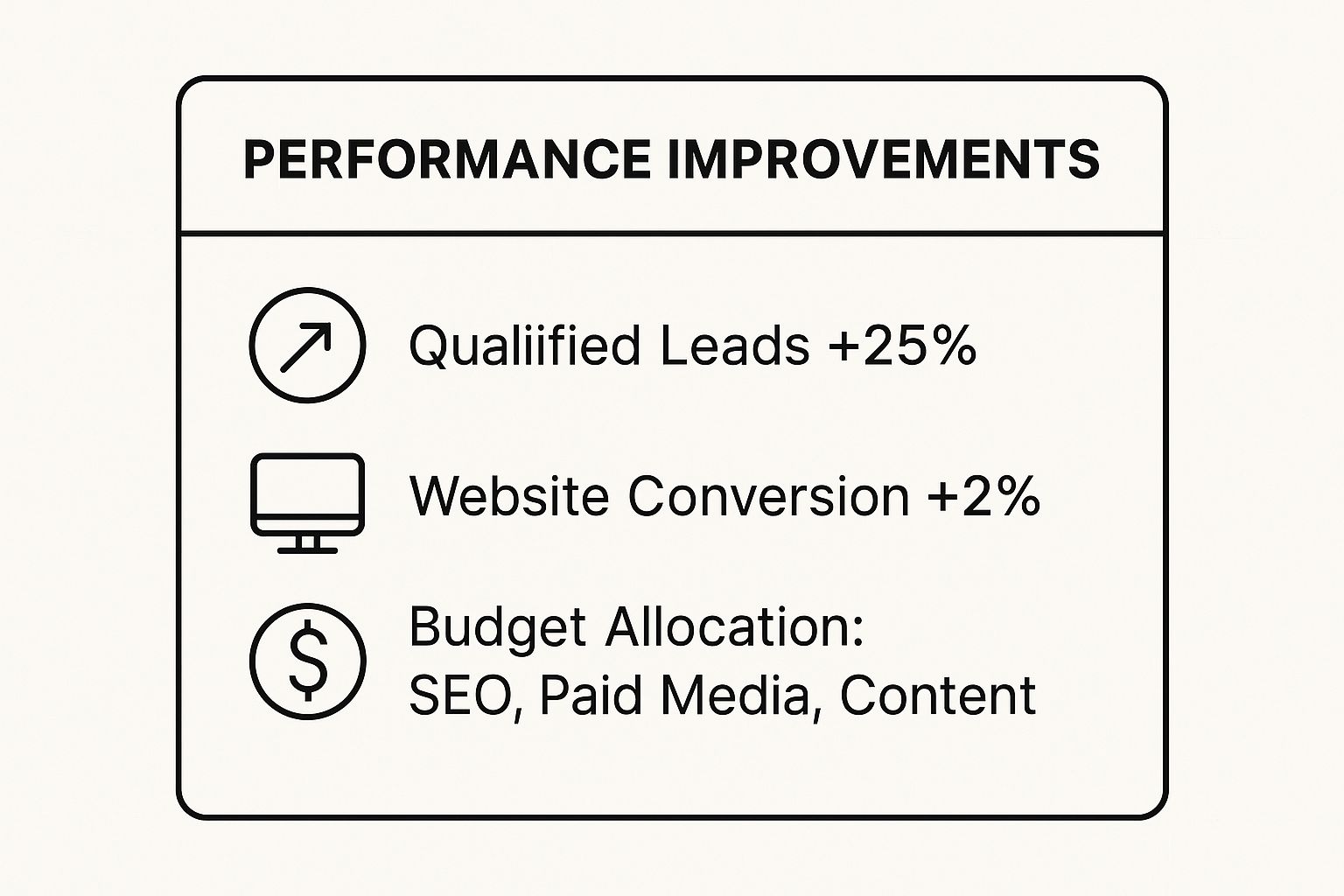
This graphic breaks down why clear goals, pinpointed targets, and a defined budget are essential before you start agency conversations.
Determining Essential Marketing Services
With goals and audience defined, decide which services will produce results. For lead generation, focus on SEO and content marketing. If you need quick sales, use paid media and conversion rate optimization.
The U.S. digital advertising agency market grew at a compound annual rate of 17.1% between 2019 and 2024. This growth was driven by higher ad spend. Find more insights on digital ad revenue at Statista.
Finally, set a realistic budget. Match your spending plan to your objectives. This allows you to have open, transparent discussions with agencies from day one.
Key Criteria For Evaluating Marketing Agencies
You have defined your goals. Now you must determine which marketing agencies can deliver. A great sales pitch is one thing, but you need a systematic way to find a true partner.
You need to investigate each candidate. You will review each candidate's experience, track record, communication style, and technical skills. Each piece of information tells you something important about how they operate and whether they can help you succeed.
Look For Real-World Industry Experience
You want an agency that already understands your industry. An agency with deep experience in your industry speaks your language from day one. It understands the unique challenges and customer behaviors you face. Specialized knowledge means a shorter learning curve and faster results.
Look for proof that they have worked with businesses like yours in size, sector, and ambition. The marketing playbook for a B2B SaaS company is completely different from a local e-commerce brand. An agency that excels at one might fail with the other.
A generalist agency can be a jack-of-all-trades, but a specialist brings a master's touch. They provide focused expertise that lines up with your industry, which often translates to more effective strategies and a much better return on your marketing dollars.
Review their website and client list. Are their case studies from your niche? Does their blog cover topics relevant to your business? If you see strong alignment, you are on the right track. For those focusing on search-driven growth, our guide to content marketing provides more context on the fundamentals.
Scrutinize Their Portfolio And Case Studies
An agency’s portfolio is direct proof of what they can do. Do not get distracted by flashy designs. You need to hunt for evidence of real performance. A good case study should clearly outline the client's problem, the agency's strategy, and the specific, measurable results they achieved.
Vague claims like “we increased brand awareness” are red flags. You need hard numbers.
- Lead Generation: Did they increase qualified leads by 35% in six months?
- Revenue Growth: Can they show a direct line from their campaigns to a client’s bottom line, like a 200% return on ad spend?
- Traffic and Engagement: Did they take a site’s organic traffic from 10,000 to 50,000 monthly visitors?
Numbers like these prove an agency delivers tangible business outcomes. An agency that is open and transparent with its data is confident in its ability to perform.
Gauge Their Communication And Reporting Style
A great partnership is built on clear, consistent communication. Pay close attention to how they interact with you from the start. Are they responsive? Do they explain things clearly? Or do you feel like you're constantly chasing them for answers?
Ask direct questions about their process:
- Who is my main point of contact? You need a dedicated account manager who knows your account inside and out.
- How often will we meet? Regular weekly or bi-weekly check-ins are important for keeping everyone on the same page.
- What do your reports look like? A report should be more than a data dump. It needs to offer analysis, insights, and clear next steps tied directly to your business goals.
Ask for a sample report. This will tell you everything you need to know about what to expect. The report should clearly track progress against the key performance indicators (KPIs) you established earlier. You also want to confirm they are proficient with modern marketing tools for analytics and automation. Proficiency with these tools is a requirement for running efficient, effective campaigns today.
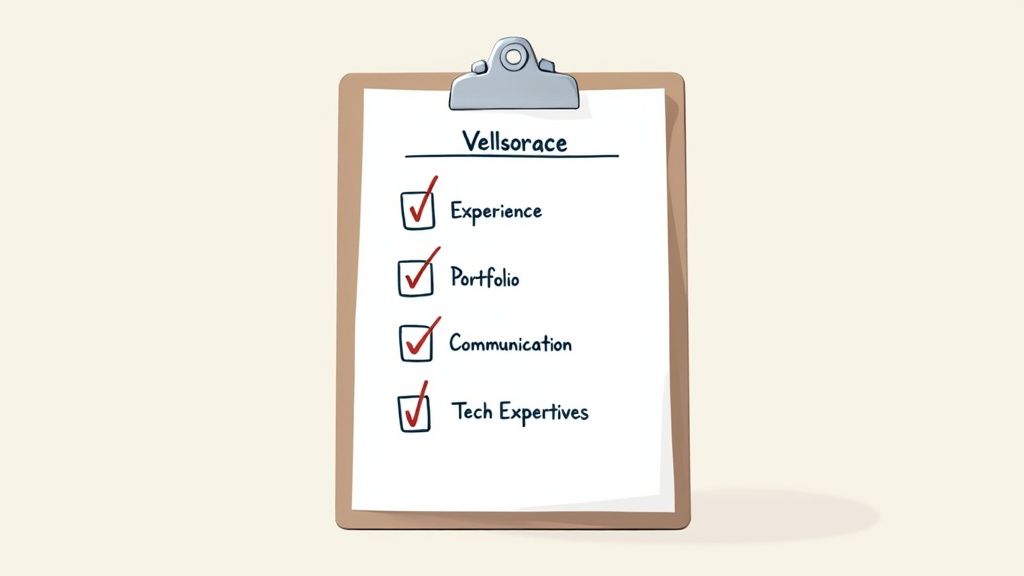
A simple checklist can help keep your evaluation organized. It ensures you compare every agency using the same criteria, making your final decision clearer.
Marketing Agency Evaluation Checklist
Using this checklist will give you a side-by-side view. It turns a complex decision into a straightforward comparison. Fill it out after each call. You will quickly see which agency stands out as the best fit for your business.
How to Assess an Agency's Track Record and Results

A slick sales pitch is one thing. A history of real-world success is something else. Before you sign a contract, you must verify an agency's claims. You need to move past vanity metrics and find hard evidence that they impact the bottom line.
You are looking for proof that they can drive outcomes that matter to your business. These outcomes include revenue growth, lead quality, or customer lifetime value. A thorough look at their past performance is the only way you will gain confidence that they can deliver on their promises.
Dig Into Their Case Studies
Think of case studies as an agency's professional resume. They need to tell a clear story, starting with a client's problem and ending with measurable results. Be skeptical of case studies that use vague terms like "increased engagement" or "improved brand visibility." Those are fluff.
You want hard numbers that connect their marketing activities directly to business goals. For example, a strong case study will show how a specific campaign led to a 40% increase in qualified leads or a 2x return on ad spend. These specific data points prove they can generate a tangible return.
The best case studies show what an agency did. They also show why they did it and how their strategic choices directly led to the client's success. This approach demonstrates a thoughtful, results-focused method.
Data is everything. You will see top-tier U.S. agencies touting impressive metrics like an 82% reduction in cost per lead or a 126% increase in site visits. This kind of success is usually the result of a smart mix of PPC, SEO, and content strategy. You can find more of these data-driven insights on agencies at a review platform like Clutch.
Speak with Their Client References
Case studies are curated success stories. To get the unvarnished truth, you must talk to their past and current clients. Any agency that is proud of its work will happily provide references. If they hesitate, that is a major red flag.
Before you pick up the phone, have your questions ready. Your mission is to understand what it is like to work with them day-to-day. This is your chance to get honest feedback on their communication, responsiveness, and problem-solving skills.
Here are a few questions I always ask:
- How did the agency handle an unexpected challenge or when a campaign was not working?
- Did their reports just show numbers, or did they provide clear, actionable insights?
- Was your main point of contact knowledgeable and easy to contact?
- Did you feel like they were a genuine partner invested in your goals?
The first question about challenges is critical. No marketing campaign is perfect. How an agency reacts when things go sideways tells you everything about their experience and their character.
Analyze the Agency’s Own Marketing
This point seems obvious, but many people skip it. A great marketing agency must practice what it preaches. Their own marketing is a living portfolio of their abilities.
Start with their website. Is it professionally designed? Easy to navigate? Most importantly, is it optimized to convert visitors?
Then, look at their entire online presence. Do they rank for their own keywords? An agency calling itself a "top marketing agency in USA" that you cannot find on Google likely does not know much about SEO.
Examine their content. A top-notch agency will produce valuable, high-quality articles and resources that establish them as thought leaders. Their blog, social media, and newsletters should all showcase a deep understanding of marketing. The principle is the same as we discuss in our guide on how to get customer reviews. It is about managing your own reputation effectively.
Finally, check their social proof. Do they have a strong profile with positive reviews on platforms like Clutch or G2? A healthy collection of authentic testimonials from happy clients is one of the most reliable indicators of quality service you can find.
Understanding Agency Structures and Pricing Models

It is a common misconception that all marketing agencies are the same. In reality, they come in all shapes and sizes. How they are structured and how they charge can make or break your partnership. Understanding these differences is the first step to finding a team that fits your company culture and budget.
An agency's setup dictates everything from its resources and agility to the depth of its expertise. The pricing model determines how you will invest your marketing dollars. Address this from the start, and you will sidestep mismatched expectations and budget blowouts later.
Comparing Different Agency Structures
The agency world is diverse, but most fall into a few common categories. Each has its own rhythm, strengths, and potential headaches.
- Large Holding Companies: Think of these as the global behemoths that own a portfolio of smaller, often specialized, agencies. They have immense resources and a global reach.
- Full-Service Agencies: These are your one-stop shops. They handle everything from SEO and paid ads to creative work and PR under one roof.
- Boutique or Specialized Agencies: These smaller firms are masters of a specific craft. They might focus solely on mobile app marketing, B2B SaaS content, or e-commerce SEO. They are often the best at what they do.
When you look at the top marketing agency in USA, the market is dominated by a handful of major holding companies. In 2024, for instance, WPP Group reported revenues of around $18.5 billion. Giants like Accenture Song and Publicis Groupe were not far behind. This data shows the market power these massive networks wield.
Navigating Common Pricing Models
Once you have a feel for the agency's structure, the next big piece of the puzzle is how they bill for their work. Most agencies use one of three main pricing models. Your choice here is not just about money. It is about budget flexibility and the kind of relationship you want to build.
Choosing a pricing model is a strategic decision. The right model should mirror your marketing goals, your appetite for risk, and how hands-on you want to be.
A mismatch can cause friction. For example, a fixed project fee is perfect for a website overhaul but makes little sense for the long, slow progress of an ongoing SEO campaign.
Retainer-Based Pricing
A retainer is a fixed monthly fee for a pre-agreed set of services or a dedicated block of hours. This is the go-to model for long-term, ongoing work where consistency is key. Examples include content creation, social media management, or SEO.
The biggest plus here is predictability. You have a set marketing expense every month, which makes budgeting simple. It also encourages a deeper partnership, as the agency becomes an extension of your team. The trade-off is you pay the same amount even during quiet periods, and unused hours usually do not roll over.
Project-Based Fees
With project-based pricing, you agree on a flat fee for a single, well-defined project with a clear beginning and end. This is ideal for one-off tasks like:
- A full website redesign
- Creating a new brand identity from scratch
- Producing a specific video marketing campaign
This approach gives you cost certainty. You know the exact price tag upfront, so there are no surprises. The danger zone is "scope creep." If the project expands beyond the original agreement, you will find yourself back at the negotiating table, often with a bigger bill.
Performance-Based Pricing
This is where things get interesting. In a performance model, the agency’s pay is tied directly to the results it delivers. Their compensation is based on hitting specific key performance indicators (KPIs), like leads generated, sales closed, or a target customer acquisition cost (CAC).
If you want to map out what this might look like, our customer acquisition cost calculator is a great place to start.
Performance-based pricing is attractive because it puts your agency's goals in perfect sync with yours. They make more money when you make more money. It lowers your upfront financial risk. The catch is that it demands crystal-clear definitions of success and rock-solid tracking to measure results without ambiguity.
Making Your Final Agency Selection
You have done the heavy lifting and narrowed the field to a handful of strong contenders. Now it is time to make the final call.
This last phase is less about shiny portfolios and more about the people, the pitch, and the paperwork. You are looking for a true partner, not another vendor. Getting this right separates a frustrating experience from a successful one.
The Final Pitch: More Than Just a Presentation
Think of the final pitch as a live audition. It is your single best chance to see how an agency thinks on its feet and applies its expertise directly to your business. This should feel like a collaborative working session, not them talking at you.
To make this count, give your top agencies a specific, real-world challenge you are facing. Ask them to come prepared with their initial thoughts and strategic framework. This simple exercise cuts through the sales fluff and shows you how they problem-solve.
During the meeting, drive the conversation with pointed questions:
- On Strategy: "Given what you know about our goals, what are your top three priorities for the first 90 days and why?" This shows if they can prioritize for immediate impact.
- On People: "Who is my day-to-day contact? Who is leading the strategy?" You need to meet the actual people you will work with, not just the sales team.
- On Reality: "Tell me about a campaign that did not go as planned. What happened, and how did you pivot?" This uncovers their honesty and adaptability when things get tough.
Also, pay attention to the questions they ask. A great agency will have done their homework. They will come with smart, insightful questions that prove they are already thinking deeply about your business.
From Proposal to Partnership: Scrutinize the Details
After the pitches, the proposals will land in your inbox. These documents are the blueprint for your potential relationship. They deserve a fine-tooth comb. Vague promises on a proposal almost always lead to unmet expectations down the road.
A solid proposal gets specific. It clearly outlines the scope of work, deliverables, timelines, and exactly how success will be measured (KPIs). If they promise "more leads," the proposal should define what a "lead" is and how they will track it.
A contract is there to protect both you and the agency. Make sure it spells out everything: scope, payment terms, reporting cadence, and how to part ways if needed. If anything is fuzzy, get it clarified in writing before you think about signing.
Drill down on these key contract components:
- Scope of Work (SOW): A detailed breakdown of every single service and deliverable.
- Term Length: Most agencies start with a six to twelve-month agreement.
- Payment Schedule: No surprises here. Just clear retainer fees, costs, and due dates.
- Termination Clause: The "out" clause. Know the conditions for ending the contract.
- Ownership of Work: Who owns the creative, accounts, and data if you part ways?
It's All About Chemistry
Never underestimate the power of a good cultural fit. You are going to be talking to these people a lot. A relationship built on trust, respect, and open communication is non-negotiable.
In those final meetings, watch how their team interacts. Do they listen? Do they talk over each other? A team that works well together is going to work well for you.
Their work style needs to sync with yours. If you thrive on collaboration and constant updates, an agency that sends a single, formal report once a month is going to drive you crazy. Finding the top marketing agency in USA for your brand means finding a team that gets results and feels like a seamless extension of your own.
Got Questions? We've Got Answers
When you are looking for the right marketing partner in the USA, a lot of questions come up. It is completely normal. Getting clear, straightforward answers is the best way to move forward and feel good about your decision. Let's tackle some of the most common ones we hear.
What’s the Real Cost of Hiring a Marketing Agency in the USA?
This is the big one. The honest answer is: it varies a lot. You could partner with a small, focused firm for a monthly retainer starting around 2,500**. On the other end of the spectrum, a large, full-service agency running a complex, multi-channel strategy could easily be **50,000 a month or more.
It all boils down to the scope of work. What you pay is directly tied to things like how many marketing channels they are managing, the amount of content they need to create, and how complex your campaigns are. Many agencies also offer project-based pricing. This is perfect for one-off jobs like a website overhaul or a big product launch campaign.
Always ask for a detailed proposal. It should clearly break down every cost so you know exactly where your money is going and what results you can expect.
How Long Should I Expect the Contract to Be?
Most agencies will want to start with a six to twelve-month contract. Do not let that scare you. There is a good reason for it. Real marketing results, especially for things like SEO and building a content engine, do not happen overnight.
This initial period gives your new partner enough runway to get past the initial setup and dive into the optimization phase. That is where the real growth happens. Once that first contract is up, many businesses roll into a month-to-month agreement for more flexibility. If the partnership is performing well, you might sign on for another year.
What Are the Red Flags I Should Watch Out For?
You have to keep your eyes open during the hiring process to avoid getting stuck with a team that cannot deliver. Some warning signs are pretty clear. For instance, if an agency guarantees you the #1 spot on Google, run. No one can ethically make that promise.
Here are a few other things to be wary of:
- Vague Reporting: If they cannot provide clear, detailed data on performance or try to dazzle you with confusing metrics, they might be hiding something.
- Bad Communication: Slow replies or fuzzy answers from the get-go? That is a preview of what working with them will be like.
- No Relevant Case Studies: They should be excited to show you examples of how they have helped businesses similar to yours.
- Hesitation to Provide References: A great agency with happy clients will have no problem connecting you with them.
Trust your gut. If a conversation feels off or their promises sound too good to be true, they probably are. The right agency will be transparent, a great communicator, and focused on setting realistic goals.
Should I Go with a Specialized Agency or a Full-Service One?
There is no right or wrong answer here. It completely depends on what you need right now. Take a look at your internal team and your biggest goals before you decide.
A specialized agency is your best bet when you need to perform well in one specific area. For example, if your entire business hinges on paid search, a dedicated PPC agency will have much deeper expertise than a generalist. That focus usually translates to smarter strategies and better results for that one channel.
A full-service agency makes more sense when you need a cohesive strategy across many different channels. It is a great option if you want a single partner managing everything from your SEO and content to social media and email marketing. It keeps your brand message consistent everywhere, though you might trade some of that deep, niche expertise you would get from a boutique firm.
Ready to grow your app with a team that blends human expertise with AI-powered insights? Adworkly specializes in driving viral growth through ASO, performance marketing, and authentic UGC strategies. Let's talk about your growth goals.