A Guide to Modern Marketing Campaigns
Build effective marketing campaigns that deliver results. This guide covers strategy, AI integration, shoppable experiences, and performance measurement.
A marketing campaign is a coordinated set of actions to promote a product, a service, or your brand. It is a strategic push using channels like social media, email, or paid ads to deliver a specific message to the right people. A solid strategy and clear, measurable goals separate a successful campaign from a failed one.
Building Your Campaign Foundation

Before you launch a campaign, you need to lay the groundwork. This foundational plan keeps your efforts focused and ensures every dollar spent and every hour worked pushes you toward your core business objectives. Improvising often leads to wasted resources and disappointing results. This planning stage defines success, understands your audience, and evaluates the competition.
Define Clear and Measurable Objectives
Your goals need to be specific and quantifiable. Vague ambitions like "increase brand awareness" are impossible to measure and do not give your team a clear target. You need to be specific.
For example, instead of saying, "get more app downloads," a stronger objective would be, "achieve a 15% increase in qualified app sign-ups from our target demographic within 90 days." This specific target gives everyone a clear benchmark for success.
Here are other examples of solid, measurable goals for a digital product:
- Increase monthly active users (MAUs) by 20% in the next quarter.
- Lower our customer acquisition cost (CAC) to under $5 for all new users from paid social.
- Improve our lead-to-customer conversion rate by 10% over the next six months.
Setting these goals upfront makes tracking progress much easier. It also helps you justify your marketing spend and prove the campaign's return on investment (ROI) later. You know exactly what you are aiming for from day one.
A well-defined objective acts as your campaign’s North Star. It guides every decision, from the channels you choose to the messages you create, ensuring all efforts are aligned.
Conduct Thorough Audience Research
You cannot market effectively if you do not know who you are talking to. Detailed audience research is essential. It helps you understand your customers' needs, motivations, and online behaviors. This insight shapes everything, from the words you use in your ads to the platforms you use to reach them.
A great place to start is by creating detailed customer personas. A persona is a character sketch of your ideal customer, assembled from market research and real data about your existing users.
Your personas should represent real people. Include details like:
- Demographics: Age, location, job title, income.
- Behaviors: Which social media platforms do they use? What blogs or podcasts do they follow?
- Pain Points: What specific problem in their life does your product solve?
- Goals: What are they trying to accomplish?
Suppose you have a fitness app. One of your personas might be "Active Alex," a 28-year-old software developer in Austin who finds workout inspiration on Instagram and listens to tech podcasts on his commute. This level of detail helps you create messages that resonate with Alex and appear in the places he already spends his time. Building a strong content marketing strategy around these personas is key to making a genuine connection.
Analyze Your Competitors
You have to know your competition. A thorough competitive analysis shows you what others in your space are doing well and where they are failing. This is where you find opportunities to stand out.
Examine your competitors' marketing. What is their messaging? Which channels are they using? What kind of content are they producing? You can use tools like Ahrefs or Semrush to analyze their website traffic, social engagement, and ad strategies.
As you research, ask yourself a few key questions:
- What is their unique selling proposition? How are they positioning themselves?
- Which keywords are they ranking for that you are not?
- What are their customers saying in reviews and on social media?
- Are there any audience segments they seem to be ignoring?
Discovering a gap in a competitor’s strategy can become your biggest advantage. For instance, if your main rival invests their budget into Facebook ads but ignores TikTok, you might have found an untapped source of potential users. This research helps you avoid their mistakes and create a unique spot for your brand in the market.
Choosing the Right Channels and Tactics
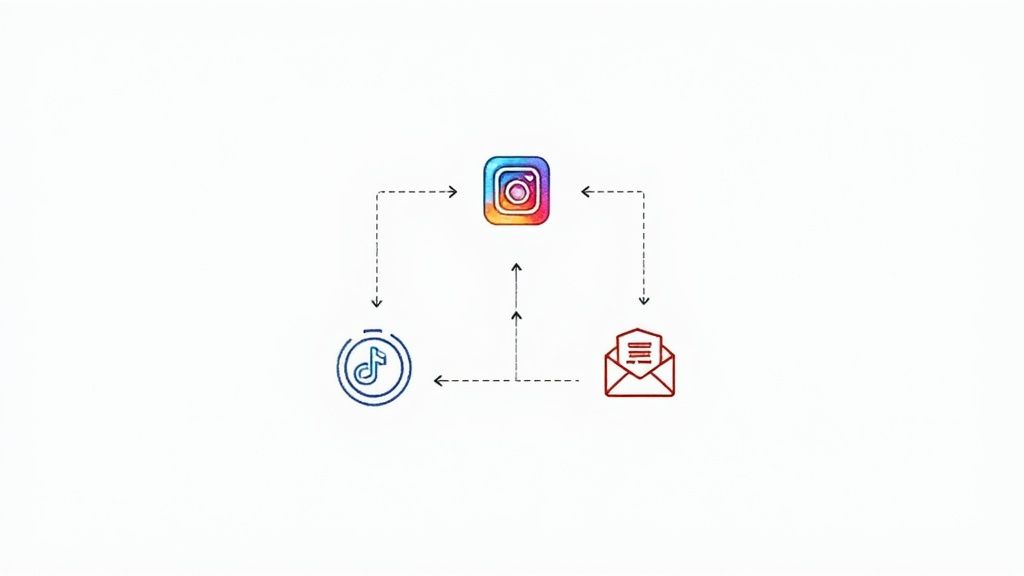
You have a solid strategy mapped out. Now you will pick your channels. This is where your campaign starts to come to life. Where you decide to put your time and money will determine if your message finds the people you have worked to understand.
The best campaigns do not just send messages out on a dozen different platforms. They build an integrated marketing mix where every channel works together. Think about it from the user's perspective. They might see your ad on Instagram, search for you on Google, and then sign up for your newsletter. It should all feel like one seamless conversation.
Evaluating Your Core Digital Channels
Every channel has its own personality and strengths. You need to match them to your goals, budget, and your audience. You have to figure out where your ideal users spend their time online and how they prefer to be addressed.
Paid social media ads on platforms like Instagram and TikTok are your go-to for immediate visibility. The targeting is precise, letting you focus on interests, demographics, and online behavior. This is effective for driving quick actions like app installs, especially if you have a compelling visual story to tell.
Search engine optimization (SEO) and content marketing are about the long game. By creating helpful articles, guides, or tools, you start pulling in organic traffic from people actively looking for solutions. It is a long-term effort, but the payoff is a steady stream of traffic that you do not have to pay for with every click.
Your marketing channel selection should reflect your audience's digital life. Go where they are. If your target persona spends hours on TikTok, investing heavily in LinkedIn ads makes little sense. Align your presence with their habits for maximum impact.
Then there is email marketing. This is your direct line to an audience that has already expressed interest in hearing from you. Use email to build relationships, announce new features, or share exclusive content. For more information, read our guide on effective email marketing strategies to get the most from your subscriber list.
Integrating Influencer Marketing
Influencer marketing has moved from a trendy tactic to a core part of many successful campaigns. It is about collaborating with creators who already have the trust of your target audience. This adds a layer of authenticity and social proof that a traditional ad cannot buy.
Finding the right partner is everything. Do not be distracted by large follower counts. Examine their engagement rates, their audience demographics, and the kind of content they create. Micro-influencers with a highly engaged niche following often drive better results for an app than a major celebrity with millions of passive followers.
The numbers support this. Global spend on influencer marketing is projected to reach $32.55 billion, and 59% of marketers plan to increase their partnerships. Also, 58% of consumers say they find new businesses through social media, proving its power for discovery. The trend is clear. People want more personal, authentic marketing. You can find more insights on these social media marketing trends on sprinklr.com.
Building a Cohesive Campaign Mix
No single channel can do it all. The strongest campaigns weave multiple channels together into one unified strategy, where each one has a specific job.
Here is what an integrated mix might look like for a new mobile app launch:
- Paid Social: Run Instagram and TikTok ads to create a large wave of initial awareness and drive app installs in the first month.
- Content Marketing: Publish a series of blog posts on topics your app addresses. This will start capturing organic search traffic from people looking for answers.
- Influencer Marketing: Partner with five micro-influencers to create authentic video reviews and tutorials. This builds trust and drives installs from their followers.
- Email Marketing: As people sign up, use a welcome email series to show them how to use the app, highlight key features, and turn them into active users.
This combination creates multiple touchpoints. Someone might first see an influencer's post, then search for more info and find your blog, and finally download the app after seeing a retargeting ad. This layered approach keeps your brand top-of-mind and builds real momentum.
Weaving AI into Your Marketing Campaigns
Bringing AI into your marketing is not about letting robots take over. It is about using practical tools that help you work smarter. When you weave AI into your workflow, you move faster, make more informed decisions, and get better results without adding more work to your plate.
Think of AI as a way to enhance your own expertise with data-driven precision. It is excellent at analyzing large amounts of data to spot patterns in user behavior that a human could miss. This introduces a new level of personalization.
Predict Your Customers' Moves
One of AI's best features is its ability to predict what your customers will do next. By looking at past interactions, purchase history, and browsing habits, these algorithms can accurately forecast who is about to convert, who is a churn risk, and what they might buy next.
For example, an e-commerce app can use AI to surface product recommendations based on items a user has recently viewed. When done right, this feels helpful, not intrusive. This predictive ability lets you be proactive instead of reactive.
AI shifts your approach from reacting to customer actions to anticipating their needs. This insight allows for hyper-targeted messaging that gets the right offer to the right person at the right time.
The impact on the bottom line is significant. Companies that bring AI into their marketing efforts see an average 25% increase in conversion rates. The global AI marketing sector is projected to grow from 20 billion in 2022 to an estimated 40 billion by 2025. You can read more about the growth of AI in marketing on cubeo.ai.
Automate Repetitive Tasks and Optimize Instantly
Much of running a marketing campaign is repetitive. AI helps here by automating time-consuming tasks so you can focus on strategy and creative thinking. This is not just about saving time; it is about improving performance.
Here is where AI gets practical:
- Paid Search Bidding: Forget manually adjusting bids. AI algorithms on platforms like Google Ads can manage them in real-time, analyzing hundreds of signals at once to maximize your return on ad spend (ROAS).
- Email List Segmentation: Instead of guessing how to group your subscribers, AI can segment your lists automatically based on engagement, purchase history, and predicted interests.
- Creative Optimization: AI tools can test thousands of ad copy, image, and headline combinations, finding the winning creative for different audiences faster than a manual A/B test.
Effective AI marketing is a continuous feedback loop. Data informs predictions, predictions drive personalized actions, and the results from those actions become new data, making the whole system smarter over time.
Sharpen Your SEO and Content Strategy
AI is also making a huge impact on search engine optimization. SEO tools powered by AI can help you perform keyword research, spot content gaps, and analyze competitor actions at a scale that was impossible a few years ago.
You can use these platforms to analyze the top-ranking pages for a keyword and get a data-backed blueprint of what topics you need to cover. It removes much of the guesswork. For more information, our guide on using AI for SEO explains more advanced tactics.
Integrating AI is about building a more intelligent and responsive marketing operation. You are not just automating tasks; you are creating a system that can adapt to customer needs in real time, leading to more effective campaigns and sustainable growth.
Creating Shoppable Experiences in Your Campaigns
The old way of marketing is gone. You cannot just show someone a product and hope they remember to find it on your website later. Today's campaigns must close the gap between seeing and buying.
The goal is to turn interest into a sale instantly. When someone sees something they love in your content, the path to purchase should be only a couple of taps away. Sending them to another site adds friction. By integrating shoppable experiences directly into your campaigns, you capture that impulse and make buying feel like a natural part of discovery.
Turn Your Content into a Point of Sale
Your social media feed is no longer just a gallery; it is a digital storefront. Platforms like Instagram and TikTok have changed the industry by allowing you to tag products directly in posts, stories, and videos.
When a user taps on a tagged item, they see the price and details, and they can go straight to checkout without leaving the app. It is a self-contained ecosystem where your audience can discover, learn, and buy in one seamless flow. Setting up a shop on these platforms is a simple decision. It makes every piece of content you create a potential source of revenue.
The results speak for themselves. The right kind of interactive content can have a massive impact on your bottom line.
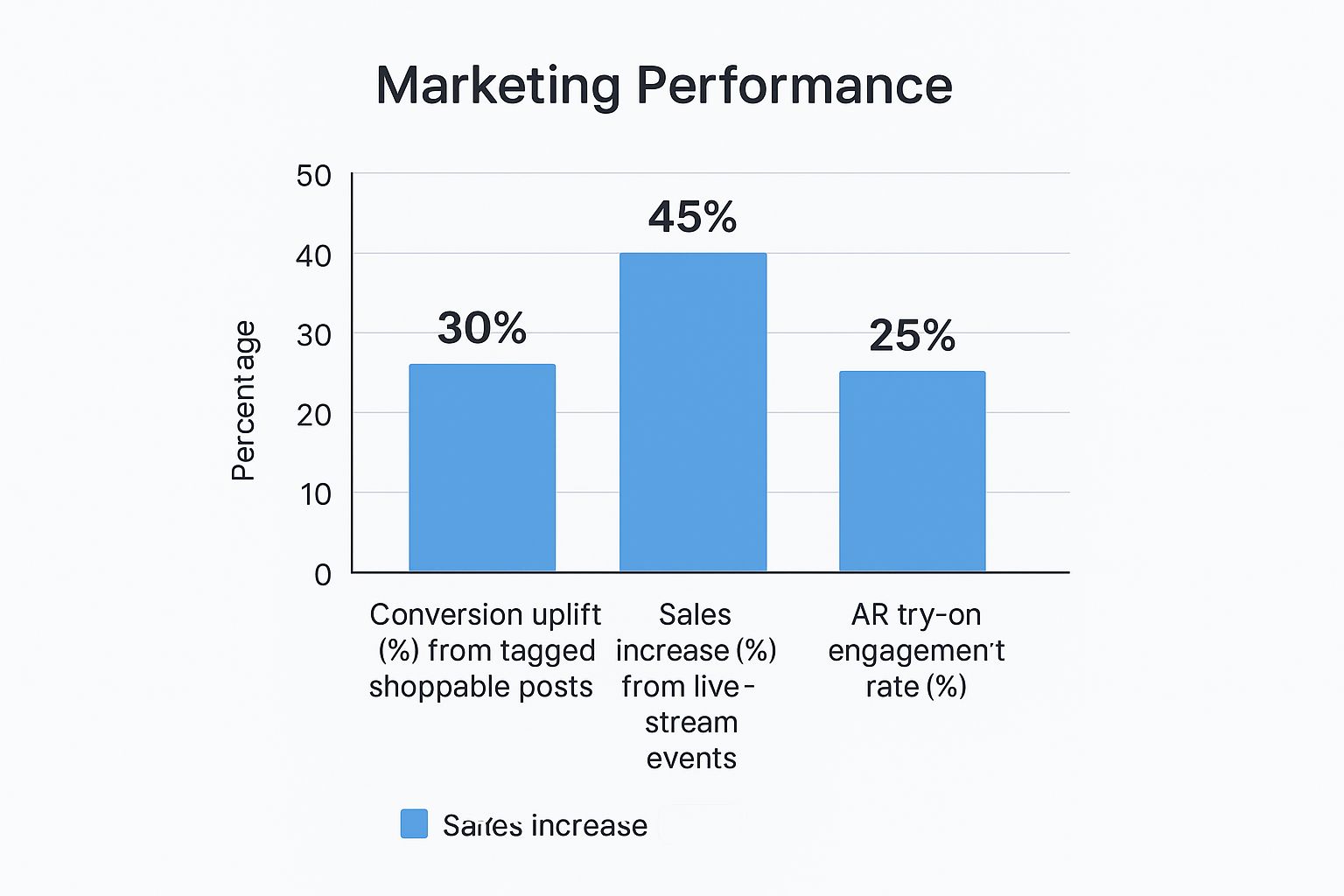
These are not just vanity metrics. We are talking about a 30% uplift in conversions from shoppable posts and a 45% sales increase from live events. That is real revenue.
Go Live and Drive Immediate Sales
Live-stream e-commerce is another effective tactic you should use. Think of it as a modern QVC, but more engaging. During a live video, you can demo products, answer audience questions in real-time, and build a sense of urgency.
The most successful live-stream events always include a few key ingredients:
- A compelling product demo that shows the product in action, not just a list of features.
- A live Q&A session to address objections and build trust.
- A limited-time offer or exclusive discount to encourage viewers to buy immediately.
This approach blends entertainment with commerce, creating a genuine community around your brand while driving sales. It feels personal and authentic, which builds loyalty.
Integrating shoppable features is all about meeting customers where they already are. When the purchase process feels like a natural extension of the content, you reduce the time it takes for them to make a decision and capture sales you would otherwise lose.
The trend is clear. Platforms like TikTok Shop are projected to generate over $20 billion in the US by 2025. In Europe, social commerce is growing at a 13% compound annual rate due to tools like Instagram Checkout. For more on this, check out the global trends shaping marketing on wearesocial.com.
Let Customers Try Before They Buy Virtually
This is where things get interesting. Augmented reality (AR) is taking shoppable experiences to a new level by letting customers "try on" products from their phone. A furniture brand can use AR to show you how a sofa looks in your living room. A beauty company can let you test a dozen lipstick shades without leaving your house.
AR addresses one of the biggest challenges in online shopping: uncertainty. It gives people the confidence to click "buy" because they can visualize the product in their own space. It is not a gimmick; it is an effective sales tool that increases conversions and reduces returns.
To create these kinds of experiences, you need a few core components working together.
Key Shoppable Experience Components
Here is a breakdown of the essential building blocks for creating effective shoppable experiences within your marketing campaigns.
Pulling these elements together allows you to build a truly integrated and frictionless path to purchase for your customers.
Whether through simple product tags, a live event, or an immersive AR feature, the mission is the same: make it very easy for an interested person to become a happy customer.
Measuring and Optimizing Campaign Performance
Getting your campaign live is a huge milestone, but it is not the finish line. The real work is just beginning. Now, it is all about continuous improvement, which is fueled by accurate measurement and smart, data-backed optimization. Without a solid process for tracking what is working, you are flying blind, wasting budget and missing growth opportunities.
This data-driven mindset separates a high-performing campaign from one that fails. Every click, conversion, and interaction is a piece of the puzzle. Your job is to gather these pieces, see the picture they form, and use that insight to make better decisions. This feedback loop is how you constantly refine your campaigns for stronger results.
Identify Your Key Performance Indicators
Before you can measure anything, you have to know what success looks like for this specific campaign. These metrics are your Key Performance Indicators (KPIs), and they must tie back to the goals you set in the planning stage. The right KPIs depend entirely on what you are trying to achieve.
For instance, a campaign to get new users for your mobile app will track different metrics than one built to generate B2B leads.
- For a Mobile App Install Campaign: You would be focused on Cost Per Install (CPI) to keep your budget in check and the user retention rate to ensure you are acquiring valuable, long-term users.
- For a Lead Generation Campaign: Here, you would watch your Cost Per Lead (CPL) to control acquisition costs and the lead-to-customer conversion rate to gauge the quality of the leads you are bringing in.
Choosing the right KPIs brings clarity. They tell you exactly what to watch and make it easy to communicate your campaign's performance to your team and stakeholders.
Use Analytics Tools to Monitor Performance
Once you know what to track, you need the right tools to do the tracking. Modern analytics platforms give you a detailed view of how people are interacting with your campaigns. Tools like Google Analytics, Mixpanel, or the built-in analytics on social media platforms are essential.
These tools let you build dashboards that pull all your most important KPIs into one place. At a glance, you can see how different channels are performing, which ad creative is earning the most clicks, and where people might be leaving your conversion funnel.
Setting up proper tracking is not optional. It is the foundation of all optimization. If your data is messy or incomplete, every decision you make based on it will be flawed.
Using conversion tracking pixels and UTM parameters lets you attribute every sign-up or purchase back to the specific ad, keyword, or social media post that drove it. This is how you figure out which parts of your campaign are delivering a positive return on investment (ROI) and which are just using up your budget. Without it, you are just guessing.
Run A/B Tests to Systematically Improve
Monitoring performance tells you what is happening. A/B testing, or split testing, helps you understand why it is happening. The idea is simple. You create two or more versions of an asset, like an ad, a landing page, or an email, and show them to different segments of your audience to see which one performs better.
A/B testing removes the guesswork from optimization. Instead of making changes based on feelings or what you think your audience wants, you use real data to guide your decisions.
Here is how that might look for a landing page test:
- Create a Variation: Your original page (Version A) is your control. Now, create a second page (Version B) with one single, specific change, like a different headline or a new color for the call-to-action button.
- Split Your Traffic: Send 50% of your incoming traffic to Version A and the other 50% to Version B.
- Measure the Results: Once you have enough visitors for the results to be statistically significant, compare the conversion rates. The version with the higher rate is your new champion.
This disciplined approach allows you to make small, incremental improvements that add up over time. You can test anything: ad images, email subject lines, or pricing offers. Each test delivers a new insight, helping you refine your campaigns for consistently better performance. This iterative cycle is the engine of sustainable growth.
Common Questions About Marketing Campaigns
When you are planning a marketing campaign, many questions come up. It is natural. Getting solid answers to these common points is the difference between moving forward with confidence and wasting money. Let's address a few of the big ones.
How Much Should I Spend on This Campaign?
"How much should I budget?" is always the first question. The honest answer is: it depends. There is no magic number. Your budget reflects your goals, the channels you are using, and the typical cost to acquire a customer in your specific industry.
The best way to get a tangible number is to work backward from your revenue targets. Suppose your goal is to land 1,000 new customers. If you know your average customer lifetime value (LTV) is around $150, you have a clear picture of the potential return. From there, you can set a customer acquisition cost (CAC) that keeps you profitable and build a budget that makes sense for your business.
What if My Campaign Is Failing?
It happens to everyone. You launch a campaign you are excited about, and the initial numbers are disappointing. The immediate temptation is to panic and stop the campaign. My advice is to act fast, but do not be rash. That early data is not a failure; it is your first set of clues.
For example, I once saw a campaign with a low click-through rate (CTR), but the few people who did click were converting at a high rate on the landing page. This tells you a few things. The problem was not the offer or the product. The issue was the ad itself. The creative or the targeting was missing the mark.
The fix was not to kill the whole campaign. We just needed to A/B test new ad copy and visuals. That one tweak turned a "failure" into a winner.
Do not be afraid to pivot based on what the data tells you. The most successful campaigns are not set in stone. They are fluid, adapting to what is happening in the real world. Sticking to a failing plan is just wasting your ad spend.
How Long Until I Know if It Is Working?
Patience is important, especially in marketing. So, how long do you wait before calling a campaign a success or a failure? It depends on your sales cycle.
If you are marketing a simple mobile app, you could have a clear picture within a week. But for a more complex B2B digital product where the sales process takes time, you might need a full month or even longer to see the complete story.
Remember, ad platforms like Google Ads and Meta have their own "learning phase." Their algorithms need time to figure out who to show your ads to for the best results. If you stop too early, you are judging the campaign before the algorithm has a chance to do its job. Patience, backed by careful monitoring, is key.
Ready to stop guessing and start growing? Adworkly combines expert strategy with AI-powered tools to build marketing campaigns that deliver results. Let us help you achieve viral growth for your app. Get started with us today.