
 UGC Infra
Influencer Marketing Platform: Elevate Your App Marketing
Discover how an influencer marketing platform can boost your app growth. Find creators, manage campaigns, and prove ROI.
Think of an influencer marketing platform as the mission control center for your creator campaigns. It’s a specialized piece of software that pulls everything together, helping brands discover influencers, manage all the moving parts of a campaign, and actually measure what's working, all from one place.
What Exactly Is an Influencer Marketing Platform

Imagine trying to orchestrate an international product launch using just spreadsheets, email chains, and sticky notes. You'd quickly drown in chaos. That's pretty much what running a large-scale influencer program feels like without the right tools.
An influencer marketing platform is the air traffic control tower for all your creator collaborations. It's not just another dashboard to check. It's the strategic hub that brings order, clarity, and efficiency to the often messy world of working with creators.
The Command Center for Creator Campaigns
At its heart, a platform is built to solve the biggest operational headaches that stop app marketing campaigns from scaling up. Instead of spending days scrolling through social media hoping to find the right partners, you get a powerful, searchable database packed with creator profiles and deep audience analytics. A great example of this is a TikTok influencer database, which is often a core component, consolidating creator data for easy access.
These platforms are designed to manage the entire lifecycle of your campaign, adding structure and automation precisely where you need it most. They bring together all the fragmented, time-sucking tasks into a single, cohesive workflow.
Here’s what that typically looks like:
- Creator Discovery: Finding the right influencers using smart filters for audience demographics, engagement rates, location, and content niche.
- Campaign Management: Keeping everything organized from sending out briefs to tracking deliverables on a central dashboard.
- Content Approvals: A simple system for reviewing and approving creator content before it goes live, ensuring it hits the mark.
- Automated Payments: Streamlining contracts and paying multiple creators on time without the administrative nightmare.
- Performance Analytics: Tracking the metrics that matter, like impressions, clicks, app installs, and return on investment (ROI).
An influencer marketing platform transforms a scattered, manual process into a scalable, data-driven system. It provides the infrastructure needed to run repeatable campaigns that predictably drive app downloads and user growth.
Solving the Struggle for Scalable Growth
For app marketers, the name of the game is scalable and repeatable growth. But manual methods have a very low ceiling. You can maybe juggle a handful of creators with emails and spreadsheets, but soon enough, communication gets messy and tracking performance becomes pure guesswork.
A platform is what smashes through that ceiling.
It gives a small team the power to manage hundreds of creator partnerships at once, all without losing control or sacrificing quality. Even more importantly, it delivers the hard data needed to prove the value of your influencer marketing spend.
By putting all your campaign data in one spot, you can finally draw a clear line from creator activity to real business results like user acquisition cost (UAC) and lifetime value (LTV). This data-backed approach is non-negotiable for justifying budgets and making smart decisions that fuel real, sustainable growth in the hyper-competitive app market.
What Really Drives App Success? A Look Inside the Platform Engine
To get why influencer marketing platforms are such a game-changer, you have to look past the sales pitches and get your hands dirty with the features that actually make them work. These tools aren't just about convenience; they're built to fix the specific, frustrating bottlenecks that stop app marketing from being a predictable, scalable way to grow.
Think of it this way: each feature is designed to tackle a different stage of a campaign, transforming what used to be manual chaos into a smooth, data-driven operation.
The need for these platforms has exploded right alongside the industry. The global influencer marketing space ballooned from roughly 8 billion** in 2019 to a massive **24 billion today. This growth, fueled by visual-heavy apps like TikTok and Instagram, has led to nearly 7,000 different agencies and service providers popping up. This is a huge leap from just over 1,100 in 2019. It’s a crowded, fragmented world, and a unified platform is the only sane way to manage it all.
Many of the best apps for social media managers touch on some of these functions, but a dedicated influencer platform brings everything under one roof.
Finding and Vetting Creators (The Smart Way)
Getting the right partners on board is everything. A top-tier platform is so much more than a simple search bar; it's an intelligent discovery engine with powerful filters that let you pinpoint the perfect creators for your app.
Instead of getting distracted by vanity metrics like follower counts, you can dive into the data that actually moves the needle.
- Audience Demographics: Filter creators by their audience's age, location, gender, and language. You need to know you're reaching your people.
- Performance Metrics: Sort influencers by what truly matters, their average engagement rate, typical video views, and click-through rates.
- Content Niche & Keywords: Find people who are already creating content in your app's world. This ensures the partnership feels natural and authentic.
- Fraud Detection: The best platforms have built-in tools to flag accounts with fake followers or sketchy engagement, protecting your budget from being wasted.
This kind of precision saves you from spending endless hours scrolling through social media and cuts out the guesswork that leads to bad partnerships. In no time, you can build a solid shortlist of vetted, high-potential creators who are a perfect match for your goals.
Streamlining Your Campaign Workflow
Once you've found your creators, the real work begins. Juggling conversations, contracts, creative briefs, and deadlines across a dozen different people can turn into a nightmare of spreadsheets and email chains. This is where a platform's workflow tools become your best friend.
A central campaign dashboard takes you from a cluttered mess to a single source of truth. It gives you a bird's-eye view of every campaign's status, making sure nothing ever slips through the cracks.
The platform essentially becomes a project management hub built specifically for influencer marketing. You get integrated messaging to keep all your conversations in one place, automated reminders so no one misses a deadline, and digital contracts to make onboarding a breeze. Many of these tools also help you figure out how to find UGC creators and manage them right alongside your traditional influencers.
Managing Content Approvals and Assets
Keeping your brand message consistent is critical, especially when you're trusting external creators to represent you. A good platform will have a content approval system baked right in, allowing your team to review and sign off on posts before they ever go live.
This simple step prevents off-brand messaging, makes sure FTC disclosures are in place, and guarantees the final product meets your quality standards. Even better, these platforms often double as a digital asset library. All the approved content gets stored in one spot, making it super easy to grab high-performing videos or images and repurpose them for your own paid ads or social channels.
Tracking Performance with Real-Time Analytics
This might be the most important feature of all. Without good data, you’re just guessing. You have no real way to measure what’s working, prove the value of your campaigns, or justify your budget.
A powerful platform gives you a real-time dashboard that tracks the metrics app marketers obsess over.
- Conversion Tracking: By integrating with mobile measurement partners, you can directly link app installs and in-app actions back to specific influencers. No more guesswork.
- Cost Per Install (CPI): See exactly how much it costs to get a new user from each creator, allowing you to quickly shift budget to your top performers.
- Engagement Analysis: Keep an eye on likes, comments, shares, and views to see which content is hitting the mark with your audience.
- ROI Calculation: The platform does the math for you, automatically calculating your return on investment and giving you the hard numbers you need to scale your program.
This data-first approach lets you make smarter decisions on the fly. You can double down on what’s working, cut what isn’t, and continuously refine your strategy to drive down user acquisition costs and achieve real, sustainable growth.
To wrap it up, these features are not just "nice-to-haves." They represent a fundamental shift in how app marketers can approach influencer partnerships. Below is a quick breakdown of how these core functions translate into direct, tangible benefits for your growth strategy.
Essential Platform Features and Their Impact on App Growth
By moving from a manual, disjointed process to a unified, data-centric one, these platforms give you the control and insight needed to turn influencer marketing from an experiment into a predictable and scalable growth channel for your app.
The Real Payoff: Why a Platform Is a Game-Changer
Knowing what an influencer platform does is one thing. Understanding how it fuels real, tangible growth is another entirely. For app founders, the benefits boil down to three massive advantages: efficiency, scale, and data-driven intelligence. It’s about replacing the grunt work and guesswork with a system built for predictable results.
If you've ever found yourself drowning in spreadsheets, email chains, and payment reminders just to manage a handful of creators, you know the pain. A platform is the antidote to that chaos. It automates the tedious, repetitive tasks that eat up your team's time, freeing them up to focus on strategy and building genuine relationships with creators. This is the first critical step in turning influencer marketing from a time-consuming chore into a powerful growth engine.
Driving Efficiency Through Automation
Let’s be honest, without a proper system, your team is probably spending way too much time on administrative busywork. Manually digging for creators, sending one-off outreach emails, tracking content in a messy spreadsheet, and chasing down invoices are all bottlenecks. This puts a hard cap on how many partnerships you can actually handle.
An influencer marketing platform puts that entire workflow on autopilot. Imagine finding the perfect creators in minutes, not days. Think about sending and signing contracts digitally and processing payments automatically. This isn't just about saving a few hours here and there. It's about reallocating your team's brainpower to the creative, strategic work that actually moves the needle.
This mind map shows how a platform's core functions interconnect to create a seamless system for growth.
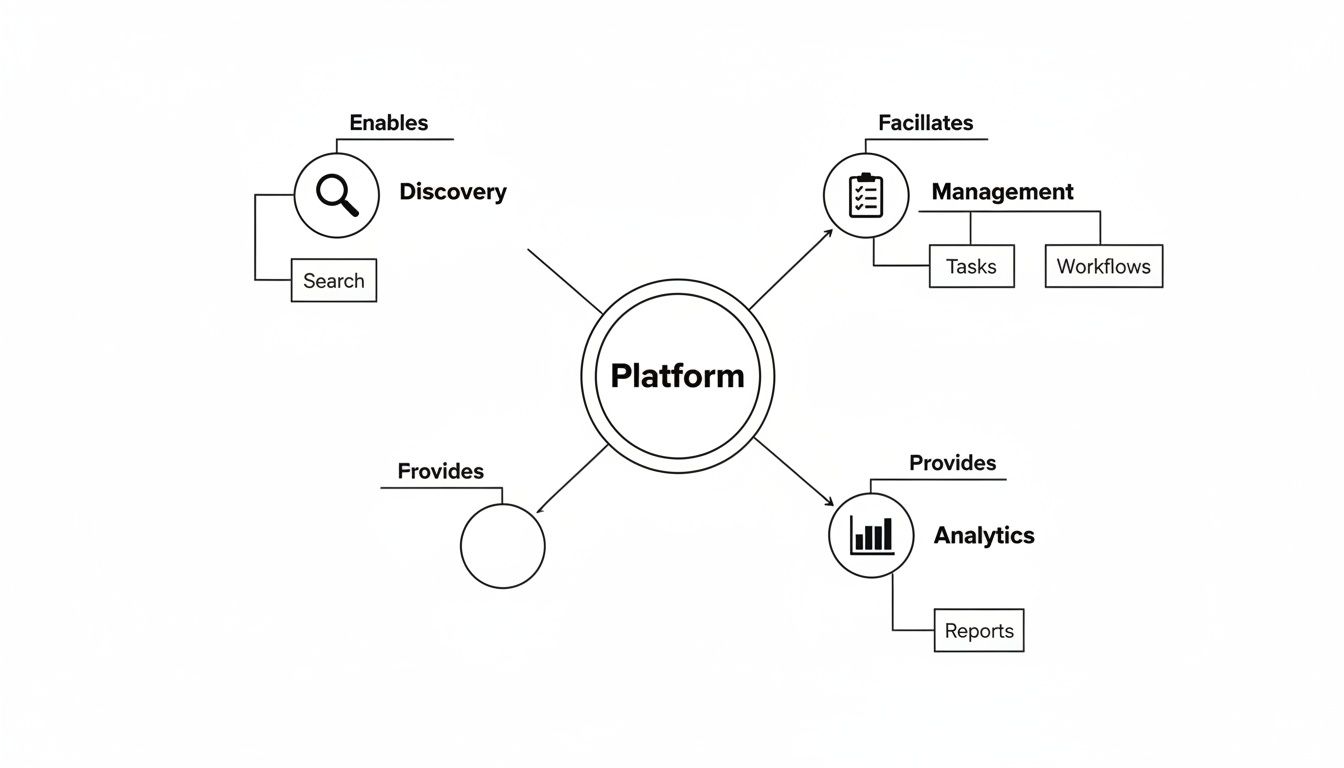
As you can see, the process flows logically from discovery to management and then to analytics, creating a powerful feedback loop where you're constantly executing and learning.
Achieving a Scale You Never Thought Possible
Here's where a platform really shows its muscle: scale. Juggling five influencer partnerships by hand is tough. Trying to manage fifty is a recipe for burnout and failure. A centralized platform shatters that ceiling, making it totally feasible for a small team to orchestrate hundreds of collaborations at once.
This is what separates one-off experimental campaigns from a reliable, ongoing growth channel. You can run multiple campaigns for different user segments simultaneously, all from a single dashboard that gives you total visibility and control. It unlocks the ability to build a diverse, far-reaching creator program that would be a logistical nightmare otherwise. To see this in action, check out some successful influencer marketing campaign examples that were built on this exact principle.
A platform transforms influencer marketing from a series of disjointed projects into an integrated, scalable system. It’s the infrastructure you need to not only handle more partnerships but to do so with better quality and consistency.
For instance, an app launching in a new country could activate dozens of local micro-influencers to create an instant buzz. A gaming app could team up with hundreds of Twitch streamers for a massive weekend launch event. These kinds of high-impact initiatives are only practical when you have the operational backbone of a platform supporting you.
Making Smarter Decisions with Data Intelligence
Maybe the most powerful benefit of all is the move from gut feelings to data-backed decisions. For years, marketers have struggled to prove the ROI of their influencer marketing spend. A centralized analytics hub finally puts that problem to rest.
When you track every campaign from one place, you can draw a straight line from a specific creator or piece of content to an app install, a user sign-up, or an in-app purchase. Suddenly, you can:
- Prove ROI with Confidence: Show your stakeholders exactly how much revenue each dollar spent on influencers is bringing back. The average is a return of $5.78 for every dollar invested.
- Optimize Your Budget: Double down on your top-performing creators and cut ties with the ones who aren't delivering. No more wasting money on partnerships that don’t work.
- Justify Future Investment: Walk into your next budget meeting with hard data to back up your request to grow your influencer program.
This level of intelligence lets you look past vanity metrics like likes and views and focus on what really matters: sustainable growth for your app. It turns your influencer program from a cost center into a predictable, measurable revenue driver.
How to Choose the Right Influencer Marketing Platform for Your App
Picking an influencer marketing platform is a big deal. You’re not just buying a piece of software; you're bringing on a strategic partner to help you scale your app’s growth. With what feels like a million options out there, it’s easy to get distracted by flashy dashboards. The real key is to look past the sales pitch and zero in on the features that actually match your app's goals and connect you with your audience.
Making this decision without a plan is a recipe for overwhelm. But if you evaluate platforms against a clear set of criteria, you can move from "Where do I even start?" to making a confident, informed choice.
Let’s break down exactly what you should be looking for.
Start With the Quality of the Creator Database
The creator database is the engine of any platform. A huge list of influencers means nothing if they aren't the right influencers for your app. The quality, depth, and relevance of the creator pool should be the very first thing you scrutinize.
Look for platforms that let you filter by more than just follower counts. You need the ability to search by specific audience demographics, like age, location, and interests. This is how you make sure you’re reaching your target users, not just shouting into the void.
On top of that, a solid platform will give you deep analytics on every creator. This means verified engagement rates, audience authenticity scores to sniff out fraud, and a track record of their past campaign performance. This is non-negotiable for vetting partners and protecting your budget.
Align Your Choice With Your Key Social Channels
Not all platforms are built the same. Some are absolute powerhouses for Instagram and TikTok, while others have much better discovery tools for YouTube or Twitch. Your app’s category will tell you which channels matter most.
For instance, a mobile gaming app will get far more mileage from a platform with a deep bench of Twitch streamers and YouTube gaming creators. A wellness app, on the other hand, should look for a partner with strong ties to Instagram and TikTok, where visual, aspirational content is king.
The data backs this up completely. Instagram is still the undisputed champ of influencer marketing, with 80.8% of US marketers making it their top priority. Globally, 57% of brands prefer Instagram, making it an essential channel for B2C apps that need eye-catching visuals to cut through the noise. And as you map out your budget, it's worth knowing that 74% of marketers plan to spend even more on Instagram. You can discover more insights about these influencer marketing stats on Backlinko.
Make Sure It Integrates With Your Tech Stack
An influencer platform can't live on an island. To get a true sense of ROI and keep your operations running smoothly, it absolutely has to plug into the marketing tools you already use. For any data-driven app marketing team, this is a deal-breaker.
Here are the key integrations to look for:
- Mobile Measurement Partners (MMPs): Connecting with tools like AppsFlyer or Adjust is crucial for attributing app installs and in-app actions directly to specific influencer campaigns.
- CRM and Email Platforms: Syncing data lets you pull leads from influencer campaigns right into your existing marketing funnels.
- Social Media Management Tools: A good integration helps you manage and repurpose all that great influencer-generated content across your own social profiles.
Without these connections, you'll be stuck manually exporting spreadsheets and trying to piece together a clear picture of your performance. It's a nightmare.
Choosing a platform is like hiring a key employee. You need to ensure they can communicate and collaborate effectively with the rest of your team and technology stack to achieve shared goals.
Understand the Different Pricing Models
Platform pricing can get confusing fast, so it’s vital to know exactly what you’re paying for. Most models fall into a few common buckets, and the best one for you hinges on your budget, how many campaigns you plan to run, and your long-term goals.
- Subscription (SaaS): You pay a recurring monthly or annual fee for access to the software. This is predictable and perfect for teams with ongoing influencer marketing programs.
- Commission-Based: The platform takes a cut of your total influencer spend. This can be a smart, cost-effective option for smaller, one-off campaigns.
- Managed Service: This is a hybrid model where you pay for both the software and the platform’s team to help run your campaigns. It’s a great fit for lean teams that need some extra hands-on support.
Always, always ask about hidden costs. Are there extra fees for adding users, running creator searches, or processing payments? A transparent pricing structure is a good sign you’re dealing with a trustworthy partner.
Questions You Need to Ask During a Demo
A product demo is your chance to really kick the tires. Don’t just sit back and watch the slideshow. Come armed with specific questions that get to the heart of your app’s needs.
Use this checklist to guide your evaluation:
- Creator Vetting: How do you verify creator data and detect fraudulent accounts?
- Channel Strength: Can you show me examples of successful campaigns for apps like mine on [Your Primary Channel]?
- Attribution: How does your platform track and attribute app installs and in-app conversions?
- Integration: Can you walk me through setting up an integration with our MMP, [Your MMP]?
- Support: What level of customer support is included in our plan, and what are your typical response times?
- Payments: How do you handle contracts, tax forms, and international payments to creators?
- Content Rights: What are the standard terms for content ownership and usage rights for the assets creators produce?
Asking pointed questions like these will help you see past the sales pitch and find a platform that’s genuinely ready to help your app win.
Integrating a Platform into Your Growth Strategy
Getting an influencer marketing platform is a great start, but the real magic happens when you weave it into the fabric of your entire marketing plan. It shouldn't be a tool that just sits in a corner, operating on its own.
Think of it as a growth multiplier. It’s the ingredient that makes everything else you’re doing, from paid ads to app store optimization, work that much better. When your influencer program syncs up with your other initiatives, you create a powerful feedback loop that turns scattered efforts into a cohesive, high-impact growth machine.
Connecting Influencers to Your Paid Media Engine
One of the quickest wins is linking your influencer platform directly to your paid user acquisition strategy. The authentic, high-quality user-generated content (UGC) from your influencer campaigns is pure gold for ad platforms like TikTok and Meta. This content just feels more real and trustworthy, and almost always outperforms those polished, studio-produced ads.
With a platform, you can stop guessing which creative will perform. Instead, you can pinpoint your top-performing influencer content using real engagement data and hand it directly to your ad team.
This approach delivers two huge benefits:
- Drastically Reduced Creative Costs: You get a constant flow of authentic ad creative without the hefty price tag of a production shoot. A single influencer campaign might give you dozens of assets to test.
- Improved Ad Performance: Because it overcomes ad fatigue and builds instant trust, UGC often drives higher click-through rates and brings down your customer acquisition costs.
By making this a regular part of your process, your paid media team gets a steady supply of winning creative. It’s not just about saving money; it’s about running smarter, more scalable ad campaigns that deliver real results.
Amplifying Your App Store Optimization Efforts
Your influencer platform can also be a secret weapon for improving your App Store Optimization (ASO). Think about it: a sudden spike in positive ratings and reviews is one of the strongest signals you can send to Apple and Google’s algorithms. It tells them your app is a hit.
You can design your influencer campaigns to do exactly that. Ask creators to encourage their followers to download the app and leave an honest review. This wave of social proof can make a huge difference in your app’s visibility and how many people decide to download it.
An integrated strategy treats influencer marketing not just as a way to get downloads, but as a tool to improve the fundamental metrics that drive long-term organic discovery.
On top of that, the brand awareness generated by influencers leads to more people searching for your app by name. When someone hears about your app from a creator they trust, their first instinct is often to head to the app store and type in the name. This jump in direct search traffic is another powerful ASO signal that can push you up the rankings for key terms. You can learn more about structuring these campaigns by reading our full guide to influencer marketing.
Creating an Interconnected Growth Loop
When you get right down to it, integrating your influencer platform is all about creating a self-reinforcing growth loop. Each channel feeds and strengthens the others, building momentum that’s far greater than the sum of its parts.
Imagine a cycle like this:
- Launch Campaign: You use your platform to kick off a campaign with a few dozen micro-influencers.
- Generate UGC and Buzz: The campaign creates a ton of authentic content and drives the first wave of downloads.
- Boost ASO: Those new users start leaving positive ratings, which improves your app store rankings and pulls in even more organic installs.
- Fuel Paid Ads: You take the best-performing UGC and use it in your paid social ads, which lowers your acquisition costs.
- Inform Lifecycle Marketing: You see which messages are resonating with new users, giving you great insights for refining your onboarding emails and retention campaigns.
This holistic approach transforms your platform from a simple management tool into the central hub of your entire growth strategy. By syncing your influencer efforts with paid media, ASO, and lifecycle marketing, you build a resilient engine that consistently attracts and keeps high-value users.
Frequently Asked Questions
When you're thinking about bringing an influencer marketing platform into your workflow, a few key questions always pop up. Let's tackle them head-on so you can move forward with a clear picture.
How Much Does an Influencer Marketing Platform Cost?
This is the big one, and the honest answer is: it depends. There’s no single price tag. The cost really hinges on what you need, including the depth of features, how many people on your team will be using it, and the sheer scale of your influencer programs.
Most platforms run on a subscription model, usually billed annually. You might find a basic plan for a small team starting at a few hundred dollars a month. On the other end of the spectrum, enterprise-level solutions with all the bells and whistles can run into several thousand dollars per month. These often include advanced analytics, a dedicated account manager, and access to massive creator databases.
Some will also offer a commission-based model, where they take a cut of your total influencer spend. This can be a decent option if you're just dipping your toes in with smaller, one-off campaigns. My advice? Always ask for a detailed price breakdown and keep an eye out for sneaky extra fees for things like payment processing or adding more seats for your team.
Can a Small App with a Limited Budget Use a Platform?
Absolutely. In fact, a platform can be a game-changer for a small team. It’s like hiring a super-efficient assistant that automates the tedious work, letting a lean team punch way above its weight. Trying to manage everything manually is a massive time-sink; a platform frees you up to think about strategy instead of spreadsheets.
Many platforms have tiered pricing designed specifically for startups and small businesses. Look for plans that give you the essentials, like creator discovery and basic campaign management, without the hefty price tag of enterprise features you don't need yet.
The right influencer marketing platform doesn't just cost money; it saves it. By preventing fraud, automating tedious tasks, and providing clear ROI data, it ensures your budget is spent on partnerships that actually drive growth.
How Is a Platform Different from an Influencer Agency?
This is a crucial distinction to make. Think of it this way: a platform is a tool you drive yourself, while an agency is a service that drives for you.
- Platform (The DIY approach): You and your team get behind the wheel. You use the software to find creators, manage the relationships, and track all the results. You're in complete control of the strategy and day-to-day execution.
- Agency (The "Done-For-You" approach): The agency's experts handle everything from A to Z. This includes strategy, finding and vetting creators, negotiating rates, and pulling together reports. You're buying their expertise and time, but you naturally give up some direct control.
Which one is right for you? It all comes down to your team's bandwidth and in-house expertise. If you have the people to run campaigns but just need better tools, a platform is your answer. If you're short on time and want to hand the keys to an expert, an agency is the way to go.
How Long Does It Take to See Results?
You'll see immediate outputs, like content going live, but measuring the real business impact takes a little patience. Generally, you can start to see meaningful performance data within the first 30 to 90 days of a campaign. This gives you enough time to see which creators are actually moving the needle on engagement and installs.
But the true value of an influencer program is built over the long haul. The end goal isn't just one-off posts; it's about building lasting relationships with creators who become genuine fans of your app. That cumulative effect, like brand awareness, social proof, and trust, really starts to shine after about six months of consistent effort.
Can Platforms Find Influencers in Niche Markets?
Yes, and this is where they really earn their keep. If your app is in a niche market, like a specialized fintech tool, a particular sub-genre of gaming, or a specific wellness category, finding the right people manually can feel like searching for a needle in a haystack.
A good influencer platform’s search filters are incredibly powerful. They let you drill down into specifics, searching by keywords, content topics, and audience demographics. This is how you uncover those amazing micro-influencers and subject matter experts who have built loyal, engaged communities around the exact topics you care about. It ensures your message lands with a passionate, ready-to-listen audience, not a broad, indifferent one.
How Do Platforms Handle Influencer Payments and Contracts?
Trying to juggle contracts and payments for dozens of creators is a logistical nightmare waiting to happen. Thankfully, a core feature of any solid platform is to make this whole process painless.
Here’s a quick look at how they typically do it:
- Digital Contracts: You can send, sign, and store legally sound contracts right inside the platform. No more chasing email attachments.
- Automated Payments: The system can automatically pay creators once their work is approved, handling different payment methods and currencies without you lifting a finger.
- Tax Compliance: Many platforms even help generate the tax forms you need, like W-9s for U.S.-based creators, which makes your finance team's life much easier at the end of the year.
This kind of centralized system saves a ton of administrative hours, cuts down on the risk of payment errors, and helps you maintain a professional, reliable relationship with your creator partners.
Ready to build the systems that put your app's growth on autopilot? Adworkly combines human expertise with AI-powered tools to design and execute creator-led campaigns that deliver measurable results.