
 UGC Infra
Email Campaigns: Marketing Strategies That Convert
Discover effective email campaigns: marketing tips to boost engagement, segment lists, craft compelling copy, and improve ROI. Get started today!
Email marketing is a direct conversation with people who are interested in your business. It is how you build relationships, guide potential customers, and drive business growth.
Building Your Email Campaign Foundation
Great email campaigns are won or lost before you hit "send." The work starts with a solid foundation built on clear goals and an understanding of your audience.
Without this strategic groundwork, your emails are noise. They get buried in crowded inboxes or ignored. A well-planned strategy ensures every email you send has a purpose and a chance to make an impact.
Defining Your Campaign Objectives
Before you write a word, ask yourself: "What am I trying to accomplish?" Vague goals like "get more customers" are not enough. You need specific, measurable objectives to steer your strategy.
Your objectives are the North Star for your campaign. They influence the audience you target and the metrics you track. A campaign designed for a flash sale looks different from one meant to onboard new users.
Here are a few common, concrete goals you might set:
- Generate new leads: Offer a high-value asset, like a free guide or webinar, to entice potential customers to sign up.
- Nurture existing leads: Guide subscribers who are not ready to buy by sending them helpful content that solves their problems.
- Promote a new product or service: Announce your launch to your most loyal fans first to build initial buzz.
- Drive repeat purchases: Keep past customers coming back with exclusive offers, smart product recommendations, and timely reminders.
- Re-engage inactive subscribers: Run a dedicated campaign to win back people who have gone quiet, using a compelling offer or an update.
A campaign without a clear objective is like a ship without a rudder. By setting specific goals, you give your email marketing efforts direction and a clear path to measure success.
The email marketing industry is projected to grow from 8.5 billion in 2021 to nearly 18 billion by 2027. An estimated 333 billion emails were sent daily in 2022. A strong foundation is the only way you will stand out.
Identifying Your Target Audience
You have your goals. Now, who are you talking to? One of the biggest mistakes marketers make is sending the same generic message to their entire list. This leads to low engagement and high unsubscribe rates.
To do this right, you need to know your audience. This means moving beyond basic demographics and creating detailed customer personas.
A persona is a fictional character representing your ideal customer, built from real data and research. It includes their professional life, motivations, and pain points. For example, you can create different personas for various types of marketing campaigns.
To build a useful persona, start by asking the right questions:
- What is their job title and what does their company do?
- What are their biggest professional challenges or frustrations?
- Where do they get information online? (e.g., blogs, LinkedIn, forums)
- What kind of content formats do they prefer? Quick videos? In-depth articles?
Answering these questions helps you step into your customer's shoes. You are not writing an email; you are sending a message that speaks directly to their needs, making your marketing personal and effective.
Growing and Segmenting Your Email List
Your email list is the heart of your marketing efforts. It is a direct line to people who want to hear from you. Building this list correctly is the foundation for everything that follows. Without a healthy, growing list of interested subscribers, even a well-written email will fail.
The goal is to attract people who are interested in what you offer. You should resist the temptation to buy email lists. It is a shortcut that leads nowhere. You will end up with terrible open rates, spam complaints, and a damaged sender reputation. Organic growth is the only way to fill your list with people who are likely to become customers.
Proven Ways to Grow Your List
To get someone's email address, you need to offer something of value. People guard their inboxes, so a generic "subscribe to our newsletter" CTA is not enough. Your offer has to be compelling.
Here are a few methods that work to pull in new subscribers from your existing traffic:
- Smart Pop-up Forms: Do not show a pop-up the second someone lands on your site. Time it to appear after they scroll or spend 30 seconds on a page. This targets users who are already engaged by your content. Offering a quick win, like a discount or a free guide, works well.
- Embedded Signup Forms: Place static forms where people will see them. Examples include your blog sidebar, the website footer, or in the middle of a relevant article. Ensure the call-to-action is specific to the page they are on.
- Content Upgrades: If you write a blog post on mobile app marketing, offer a bonus resource like "The 10-Point App Launch Checklist" for their email. It is an irresistible offer for someone already invested in that topic.
These tactics are effective because you catch people at their peak moment of interest, making them more likely to subscribe.
Why You Cannot Skip Segmentation
Once people subscribe, the work begins. You have to start segmenting. This is the practice of splitting your large list into smaller, more focused groups based on specific traits or actions. Sending the same message to everyone is a sure way to get ignored.
When you segment, you can send relevant messages that speak directly to what each group cares about. The results are clear. Marketers who use segmented campaigns report as much as a 760% increase in revenue. Personalized content gets opened, gets clicked, and gets people to act.
Segmentation turns your email marketing from a generic broadcast into a one-on-one conversation. When subscribers get content that feels like it was written for them, they stick around.
A brand-new subscriber needs a welcome sequence that introduces your brand and sets expectations. A long-time loyal customer would appreciate early access to a new product or an exclusive offer. Sending the wrong message to either of them feels off and weakens the connection you have built.
How to Segment Your Audience
You can slice your audience data in many ways. The trick is to pick criteria that support your business goals. My advice is to start simple and add more complex segments as you learn about your subscribers' habits.
Here are the three main ways I approach segmentation:
- Demographic Data: This is the basic "who they are" information: age, location, job title, company size. A B2B software company would talk differently to a startup founder than to a marketing manager at a large corporation.
- Behavioral Triggers: This is about "what they do." You can create segments for people who opened a specific email, clicked on a certain link, viewed a product page, or abandoned their shopping cart.
- Purchase History: Grouping customers by what they have bought, how often they buy, and how much they spend is effective. For any e-commerce store, this allows targeted cross-sells, upsells, and loyalty campaigns that work.
For instance, a fitness app could automatically segment users who finished a "beginner" workout series. The logical next step is to send them an email encouraging them to try an "intermediate" plan. It is helpful, relevant, and guides them deeper into your product.
Designing Emails That People Read
Your email's design is the first thing people judge. It determines whether they will read what you wrote or send it to the trash. A thoughtful design guides the eye, makes your message easy to understand, and encourages people to click. Without it, even the best offer gets lost.
That experience starts before they open the email. It starts with the subject line. This is your first impression. For many in your audience, it is your only one. 47% of people decide whether to open an email based on the subject line alone. Your mission is to be clear and compelling without tripping spam filters.
Writing Subject Lines That Earn the Open
Your subject line is fighting for attention in a crowded inbox. It has to be interesting enough to spark curiosity but also honest about what is inside. Nobody likes a bait-and-switch. Misleading subject lines are the fastest way to kill trust and get unsubscribes.
Put yourself in their shoes. What makes you open an email? It is usually a mix of curiosity, a sense of urgency, or a clear promise of value.
Here are a few angles I have seen work:
- Ask a Question: A subject line like "Is your app ready for the holidays?" gets the reader thinking about a specific problem you can solve. It is direct and engaging.
- State a Clear Benefit: Something like "Increase user retention by 20% with this tip" is a home run. It tells subscribers exactly what they will get for their time.
- Create Urgency (Sparingly): Phrases like "24 hours left for 50% off" are effective for time-sensitive promotions. Do not overdo it, or you will train your audience to ignore you.
Keep it short. With over 60% of emails now opened on mobile, long subject lines get cut off. I aim for 50 characters or less to ensure the whole message gets through.
Structuring Your Email for Readability
Once they click open, the clock is ticking. You have a few seconds to convince them to stick around. People do not read emails, they scan them. A giant wall of text is an instant delete.
Your job is to make your email as scannable as possible. Stick to short paragraphs of one to three sentences. This creates white space that makes your content feel less intimidating and easier to skim on any device.
An email’s layout is as important as its words. A clean, simple structure respects your reader’s time and helps them find what they are looking for, fast.
Use headings and subheadings to break your content into logical chunks. This lets subscribers jump to the sections that matter most to them. For example, a promo email might have headings like "New Features You'll Love" and "Grab Your Limited-Time Offer."
This visual guide breaks down a simple, effective structure for your email campaigns.
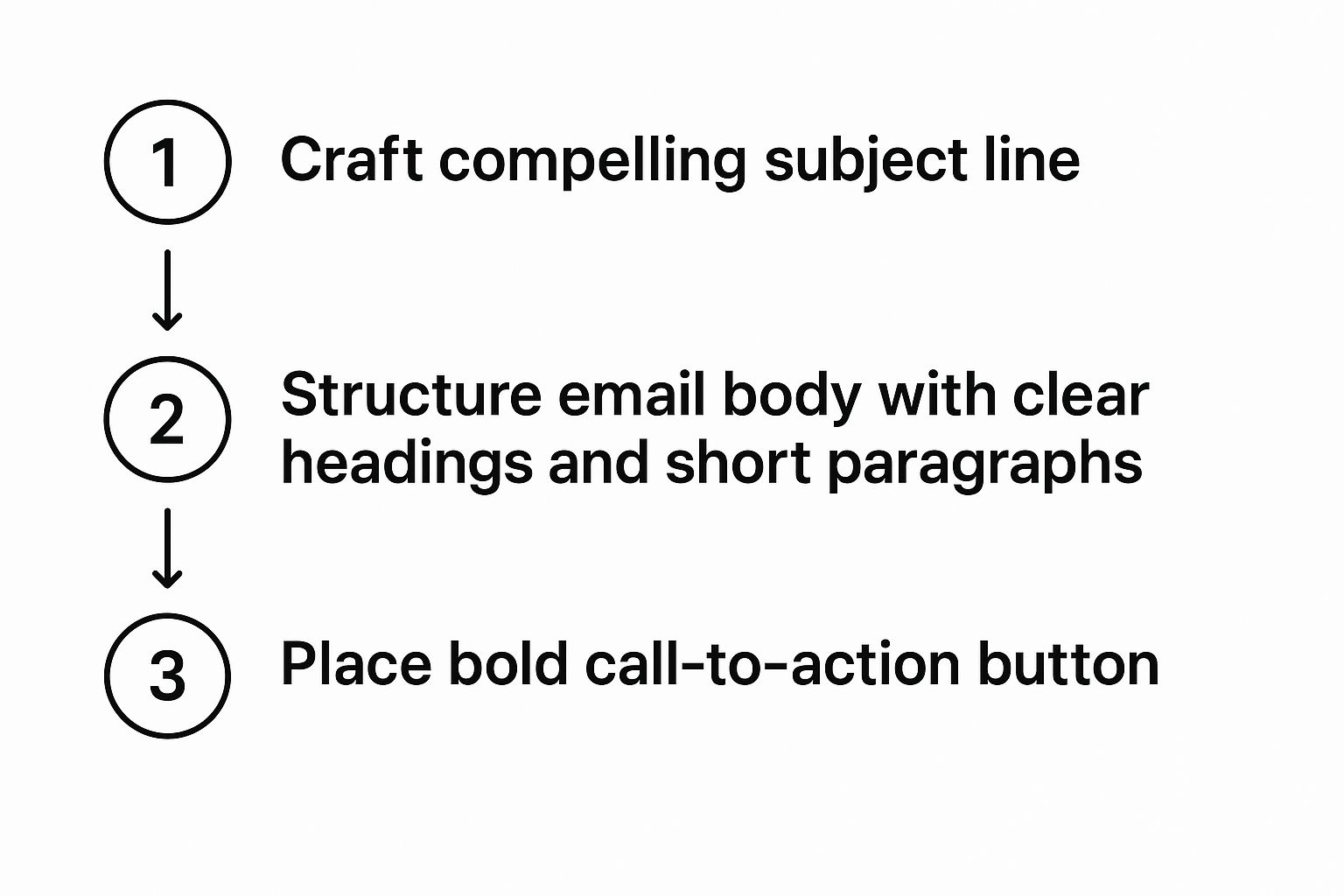
This proven flow, from a compelling subject line to a clear call-to-action, is your roadmap to better engagement.
The Power of a Strong Call to Action
Every email you send needs one clear goal. Your call to action (CTA) is how you get your reader there. It needs to be the most obvious thing on the page. Use a button with a bold, contrasting color that screams "click me!"
The words on that button matter, too. Ditch generic phrases like "Click Here" or "Submit." Instead, use action-oriented language that tells people what will happen next.
A few strong CTA examples:
- Get Your Free Trial
- Download the Guide Now
- Shop the New Collection
Place your CTA where someone would naturally look after reading your message. If you have a longer email, do not be afraid to include the button more than once, perhaps one near the top and another at the end. These design choices are part of a bigger picture. For more on that, check out our guide to content marketing.
Ensuring a Mobile-First Experience
Designing for mobile is everything. A clunky mobile design is a top reason people unsubscribe. Your email has to look fantastic and work perfectly on a tiny screen.
This means a single-column layout is your best friend; it is simple to scroll through. Use a font size that is large enough to be read comfortably without pinching and zooming. Any images need to be optimized so they load quickly, even on a weak cellular connection.
Before you send any campaign, do this one simple thing: send a test to yourself and open it on your phone. This quick check will save you from common and avoidable design mistakes.
Using Automation And Personalization To Scale
https://www.youtube.com/embed/JtdUgJGI_Oo
If you want to grow, you cannot manually send every email. It is not possible. This is where automation and personalization come into play, forming the engine of any modern email marketing program built to scale.
Think of automation as a series of "if-then" recipes. If a subscriber does this (the trigger), then they automatically get that (the email sequence). A trigger can be anything: signing up for your list, clicking a link, making a purchase, or ignoring your emails for a few months. When that trigger is tripped, it kicks off a pre-built series of emails designed for that moment, ensuring you send the right message at the right time. Every time.
Setting Up Your Must-Have Automated Workflows
You can create an automated workflow for any customer scenario, but a few core sequences deliver the most impact. These are the campaigns that should work for you in the background 24/7, nurturing leads and strengthening customer relationships while you focus on other things.
If you are just starting, get these three foundational sequences running first:
- The Welcome Series: That first impression is everything. When someone new joins your list, a welcome series is your chance to introduce your brand, set expectations, and deliver instant value. A simple three-part series is more effective than a single welcome email.
- The Abandoned Cart Reminder: For anyone selling online, this is non-negotiable. Someone adds a product to their cart but gets distracted and leaves. An automated email that lands in their inbox a few hours later, reminding them what they left behind, is often the perfect nudge to bring them back and close the sale.
- The Re-engagement Campaign: Over time, some subscribers will go quiet. A "win-back" campaign automatically targets contacts who have not opened your emails in a while, for example, 90 days. This sequence can reignite their interest with a special offer or a quick update on what they have missed.
These tools have reshaped the industry. By early 2024, email marketing had become the channel most dependent on automation, with 58% of marketing professionals using it. AI has pushed things further, with over half of marketers saying it directly improved their email effectiveness. You can dig into more of this data on email marketing technology over at Statista.com.
To get a clearer picture, here is a breakdown of some of the most effective automated campaigns you can set up.
Essential Automated Email Campaigns
These automated sequences are the building blocks of a relationship-focused email strategy that works for you even when you are not working.
Moving Beyond "Hi, [First Name]"
Real personalization goes deeper than dropping a subscriber's first name into the subject line. It is about using what you know about your audience to give them an experience that feels unique and helpful. When people feel understood, they become loyal.
This is where dynamic content comes in. These are blocks within a single email that change based on who is opening it. For example, a clothing brand can send one campaign, but a female subscriber sees the new women’s collection while a male subscriber sees the men's line. It is the same email, but the content adapts.
Personalization shows your subscribers you are paying attention. Using data to tailor your content transforms a generic broadcast into a relevant, one-to-one conversation.
This level of customization depends on having good data. The more you learn about your subscribers and the better your segmentation, the more you can personalize your automated campaigns.
The Magic Happens When You Combine Automation and Data
The real impact begins when you fuse your automation with rich, personal data. A standard automated workflow becomes effective when it starts pulling from specific subscriber details.
Imagine an abandoned cart email. It is good if it reminds them of the product. But it is great if it also includes a few glowing customer reviews for that exact item.
Or think about a birthday email. Sending an automated message on a subscriber's birthday with a special discount feels personal and thoughtful. It is a simple, automated touch that builds goodwill and often drives a sale. By using data to inform your triggers and personalize your content, your emails stop feeling like marketing and start feeling like a valuable service.
Measuring and Optimizing Campaign Performance
Hitting "send" on a campaign is not the finish line. It is the starting block. The part that drives growth happens after the email lands in the inbox. You have to analyze the data to see what worked and what did not. Otherwise, you are just guessing.
This is where you shift from art to science. By tracking the right numbers, you get direct feedback from your audience. Their clicks and opens tell you exactly what they want, guiding every campaign you send next.
Key Performance Indicators You Must Track
Your email platform’s dashboard is packed with data, but you do not need to track everything. A handful of key performance indicators (KPIs) will tell you 90% of the story. Focusing on these will keep you from getting lost in the noise.
For every campaign, keep your eyes on these core metrics:
- Open Rate: This is the percentage of people who opened your email. If this number is low, your subject line did not work, or your list might need a clean-up.
- Click-Through Rate (CTR): This shows how many recipients clicked on at least one link. Your CTR is a direct reflection of how engaging your content and call-to-action were.
- Conversion Rate: This is the big one. How many people completed the goal, whether that was making a purchase, downloading a guide, or booking a call. It ties your email directly to business results.
- Unsubscribe Rate: The percentage of people who opted out. A sudden spike here is a major red flag that your content is not hitting the mark or you are sending too frequently.
Think about how these metrics work together. A high open rate with a low CTR tells a specific story: your subject line was great, but the email failed to persuade. That is an insight that tells you exactly what to fix.
The Power of A/B Testing
Want to improve your numbers? Start A/B testing. It is the most reliable way to make your emails better. It is a simple concept: you send two versions of your email, with one small difference, to a small slice of your audience. The version that gets more opens or clicks is the winner, and you send that one to everyone else.
A/B testing takes the guesswork out of your strategy. Instead of your team debating which subject line feels right, you let your subscribers vote with their actions. You can test almost anything.
Here are a few great places to start with A/B tests:
- Subject Lines: Try a clear, straightforward subject line against one that creates curiosity.
- Call to Action (CTA): Test different button copy. Does "Shop Now" work better than "Explore the Collection"?
- Email Content: Pit a short, punchy email against a more detailed, long-form version.
- Sender Name: Does an email from "Jane at Adworkly" outperform one from "Adworkly"? You might be surprised.
A data-driven approach is what separates good email marketers from great ones. Consistent A/B testing gives you the small, incremental wins that add up to massive gains over time.
This commitment to constant refinement is why email marketing is so profitable. The data shows email marketing can generate between 36 and 40 for every dollar you put in. That is an ROI of up to 4,000%. This is fueled by growing engagement, with click-to-conversion rates jumping by 27.6% in 2024. For more on this, check out these email marketing ROI statistics at Omnisend.com.
Interpreting Your Campaign Results
Once a campaign is done, it is time to analyze the results and figure out what they mean for your next move. Look at your KPIs and ask why. Why did that one email get such a high CTR? Did that 20% off coupon cause a spike in unsubscribes? Every campaign is a lesson.
This analysis is how you fine-tune everything: your segments, your content, your offers. It also helps you get a handle on profitability. When you track conversions and revenue back to specific emails, you start to understand the financial impact of your list. You can even use our customer acquisition cost calculator to get a clearer view of your marketing spend.
This cycle of measuring and optimizing will turn your email program into your most reliable marketing channel.
Common Questions (and Expert Answers) About Email Campaigns
Even experienced email marketers run into questions. From landing in the spam folder to figuring out the perfect sending schedule, certain challenges come up again and again.
Let's walk through some of the most frequent questions I hear from marketing teams and get you the straightforward answers you need to keep your campaigns running smoothly.
How Can I Improve My Email Deliverability?
Deliverability is everything. If your emails do not hit the primary inbox, nothing else matters. It all boils down to your sender reputation, which is the score Internet Service Providers (ISPs) like Gmail and Outlook assign to you based on how your subscribers interact with your emails. If people consistently open your messages, that is a good signal. If they ignore them or mark them as spam, your reputation takes a hit.
Protecting that reputation is your top priority. Here is how you do it:
- Authenticate Your Domain: This is non-negotiable. Set up your SPF and DKIM records. Think of these as a digital passport that proves to ISPs you are who you say you are, not a spammer.
- Keep Your List Clean: Routinely scrub your list of inactive subscribers, anyone who has not opened an email in 90 to 180 days. Sending to people who are not listening tells ISPs your content is not valuable.
- Watch Your Language: Avoid classic spam trigger words. Anything that sounds too good to be true, like "free," "winner," or using too much punctuation (!!!), can send your email straight to the junk folder.
Think of your sender reputation as your most valuable asset in email marketing. Guard it carefully.
What Is The Best Way To Handle Unsubscribes?
First things first: unsubscribes are not a bad thing. It might feel like a rejection, but it is a healthy sign. People’s needs change. You are better off letting someone leave gracefully than having them stick around and eventually mark your emails as spam. As a benchmark, an unsubscribe rate below 0.5% is considered healthy.
The golden rule is to make unsubscribing painless. The link should be clear and easy to find in every email, typically in the footer. Burying it is a mistake that creates a terrible user experience and invites spam complaints, which are more damaging to your deliverability than a simple opt-out.
The unsubscribe process is another touchpoint in your customer experience. A simple, one-click process shows you respect your audience's time and choice. It also does you a favor by keeping your list clean.
Never try to guilt-trip or trick someone into staying. A smaller, engaged list will always outperform a large list of people who do not care.
How Often Should I Send Marketing Emails?
Finding the right sending frequency is a delicate balance. You need to stay on your audience's radar without becoming a nuisance. There is no magic number here. The right answer depends on your industry, what you are sending, and what your subscribers expect from you.
A B2B company might find success with a high-value weekly newsletter, while an e-commerce brand sending daily flash sales might quickly burn out its list.
To find your rhythm, you need to listen to your audience:
- Set Expectations Upfront: Use your sign-up form to tell people what they are getting into. "Get our weekly tips" or "Receive daily deals" sets the stage immediately.
- Let Your Audience Choose: The best way to know what people want is to ask them. A preference center allows subscribers to choose their own frequency, whether that is daily, weekly, or just monthly roundups.
- Test, Measure, and Adjust: Send campaigns at different cadences to small segments of your list and watch the numbers. If your open and click rates start to dip while unsubscribes spike, you have your answer. You are sending too often.
Your data will tell you the truth. Pay attention to how your subscribers behave, and you will find the sweet spot.
Ready to grow your app with expert strategy and execution? The team at Adworkly combines human expertise with AI to help you achieve viral growth. Learn more about how we can scale your success.